
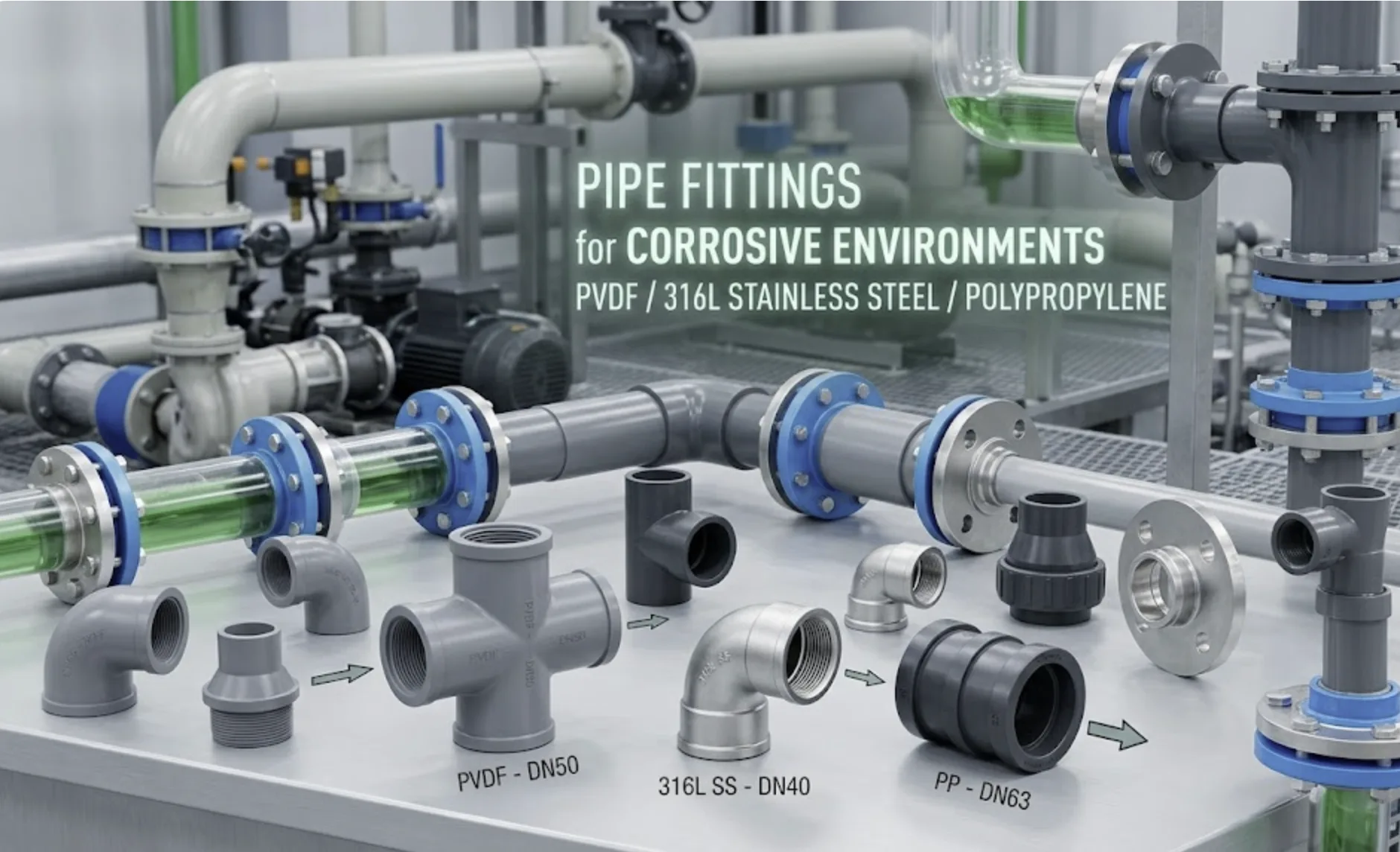
Strategic Material Selection for Pipe Fittings in Corrosive Environments
Selecting the appropriate pipe fittings for corrosive environments is a critical engineering decision that impacts the longevity and safety of industrial fluid handling systems. Corrosion accounts for billions of dollars in infrastructure damage annually, with the National Association of Corrosion Engineers (NACE) estimating the global cost of corrosion at approximately $2.5 trillion USD. In chemical processing, mining, and wastewater treatment, traditional metallic fittings often succumb to oxidation and galvanic corrosion. Transitioning to advanced thermoplastic solutions, such as high-performance CPVC pipe fittings, provides a chemically inert alternative that resists aggressive acids, bases, and salts. Proper selection requires analyzing chemical concentration, operating temperature, and the specific mechanism of degradation.
Technical Comparison of Thermoplastic Materials for Chemical Resistance
The chemical resistance of a fitting is determined by its molecular structure and the stability of its polymer chains. PVC, CPVC, and PPR are the primary materials utilized in non-metallic piping. According to the Plastics Pipe Institute (PPI), CPVC (Chlorinated Polyvinyl Chloride) offers enhanced resistance to high-temperature corrosive fluids compared to standard PVC due to its higher chlorine content. While PVC is suitable for mild acids and ambient temperatures, PPR pipe fittings are often preferred for hot water distribution and industrial cooling loops where chemical purity is essential. The selection of a material must align with the ASTM D1784 standards for rigid compounds to ensure the fitting can maintain its physical properties under chemical stress.
Chemical Resistance Rating Table for Common Industrial Fluids
| Chemical | Concentration | Resistance 1 | Resistance 2 | Resistance 3 |
|---|---|---|---|---|
| Sulfuric Acid | 70% | Resistant | Resistant | Limited |
| Hydrochloric Acid | 38% | Resistant | Resistant | Resistant |
| Sodium Hypochlorite | 15% | Resistant | Resistant | Not Recommended |
| Sodium Hydroxide | 50% | Resistant | Resistant | Resistant |
| Nitric Acid | 10% | Resistant | Resistant | Limited |
Impact of Temperature on Corrosion Rates and Fitting Integrity
Operating temperature is a primary catalyst for chemical reactions that accelerate material degradation. For every 10°C increase in temperature, the rate of chemical attack on a material can potentially double. This thermal sensitivity necessitates the use of derating factors for pressure-bearing components. In high-temperature corrosive environments, industrial ball valves must be paired with fittings that share identical thermal expansion coefficients to prevent joint stress. Data from the National Institute of Standards and Technology (NIST) indicates that thermal cycling can exacerbate Environmental Stress Cracking (ESC) in lower-grade plastics. Engineers must verify that the selected fitting maintains a safety factor of at least 2.0 at the maximum projected operating temperature.
Specialized Valve Integration in Corrosive Fluid Systems
A fluid handling system is only as reliable as its weakest connection point, which is frequently the interface between the pipe and the valve. In corrosive environments, selecting a pvc octagonal ball valve ensures that the internal flow path remains free from the pitting and scaling common in metal alloys. Furthermore, automation in corrosive environments often utilizes 2/2-way solenoid valves made of engineered polymers or with specialized coatings to prevent chemical ingress into the electrical actuators. The Environmental Protection Agency (EPA) emphasizes the importance of secondary containment and leak-proof fitting selection to prevent hazardous chemical release into the environment during valve operation or system maintenance.
Evaluating Mechanical Stress and Flow Dynamics
Corrosion is often accelerated by mechanical factors such as high flow velocity and turbulent flow patterns, a phenomenon known as erosion-corrosion. When abrasive particles are present in a corrosive fluid, the protective surface layer of a fitting can be physically removed, exposing fresh material to chemical attack. Technical reports from the Hydraulic Institute (HI) suggest limiting flow velocities to 5 feet per second (1.5 m/s) in thermoplastic systems to minimize wall thinning. Utilizing smooth-bore HDPE pipe fittings reduces the friction coefficient (Hazen-Williams C factor), which maintains laminar flow and decreases the likelihood of localized erosion at elbows and tees.
Comparative Friction Coefficients
| Pipe Material | Temperature Rating | Corrosion Risk |
|---|---|---|
| Polypropylene (PPR) | 150 | Extremely Low |
| Polyvinyl Chloride (PVC/CPVC) | 150 | Extremely Low |
| High-Density Polyethylene (HDPE) | 150 | Extremely Low |
| New Ductile Iron | 120 | Moderate |
| Cast Iron (10 years old) | 100 | High |
Prevention of Environmental Stress Cracking
Environmental Stress Cracking is a failure mechanism where a fitting develops micro-fractures under the combined influence of tensile stress and a specific chemical agent. Unlike general corrosion, ESC does not cause chemical degradation of the polymer; instead, it physically weakens the intermolecular bonds. This is particularly prevalent in joints where excessive solvent cement has been applied or where mechanical threads have been over-tightened. To mitigate ESC risks, the Occupational Safety and Health Administration (OSHA) recommends standardized training for pipe fusion and solvent welding. Selecting industrial butterfly valves with elastomeric seals compatible with the transported media is also vital to prevent chemical migration into the fitting’s joint interface.
Guidelines for Selecting Corrosion-Resistant Fittings
-
Chemical Concentration Analysis: Identify all chemicals present, including trace contaminants, as even small amounts of oxidizing agents can alter material compatibility.
-
Thermal Profile Assessment: Determine the steady-state, minimum, and maximum surge temperatures to apply the correct pressure derating factors.
-
Pressure Rating Validation: Ensure the fitting’s Schedule 80 or PN rating exceeds the system’s maximum operating pressure, accounting for potential water hammer.
-
Seal and O-Ring Compatibility: Verify that FKM, EPDM, or Nitrile seals used in valves and unions are resistant to the specific chemical medium.
-
Installation Environment: Consider external factors such as UV exposure or soil chemistry if the fittings are installed outdoors or buried.
FAQ
What is the difference between chemical resistance and corrosion resistance?
Chemical resistance refers to a material’s ability to withstand structural change when exposed to specific substances. Corrosion resistance typically describes a material’s ability to resist electrochemical oxidation (rusting), which is a specific type of chemical reaction common in metals but absent in most thermoplastic pipe fittings.
Can CPVC fittings be used with all industrial acids?
CPVC is highly resistant to most mineral acids and bases at elevated temperatures. However, it is susceptible to damage from polar organic solvents, such as ketones, esters, and some aromatic hydrocarbons. Always consult a chemical resistance chart for the specific grade of CPVC resin utilized in the fitting.
How does flow velocity affect the life of a fitting in a corrosive system?
Higher flow velocities increase the frequency of chemical molecules contacting the fitting’s internal surface. If the fluid contains solids, high velocity causes erosion, which strips away the material’s passivated surface. Keeping velocities below 1.5 m/s is the industry standard for extending the service life of plastic components.
Are threaded fittings better than solvent-welded joints in corrosive environments?
Solvent-welded joints are generally superior because they create a monolithic bond that eliminates the gaps and stress concentrations found in threads. Threaded joints are more susceptible to crevice corrosion and leakage if the chemical agent attacks the thread sealant or causes the plastic to swell or shrink.
How do I identify a fitting that is failing due to corrosion?
Warning signs include localized discoloration (blanching), surface crazing (small cracks), swelling of the fitting wall, or a sudden increase in brittleness. In advanced stages, “weeping” may occur at joints, or the fitting may undergo a catastrophic brittle fracture even if the pressure remains within the rated limits.


