
Introduction
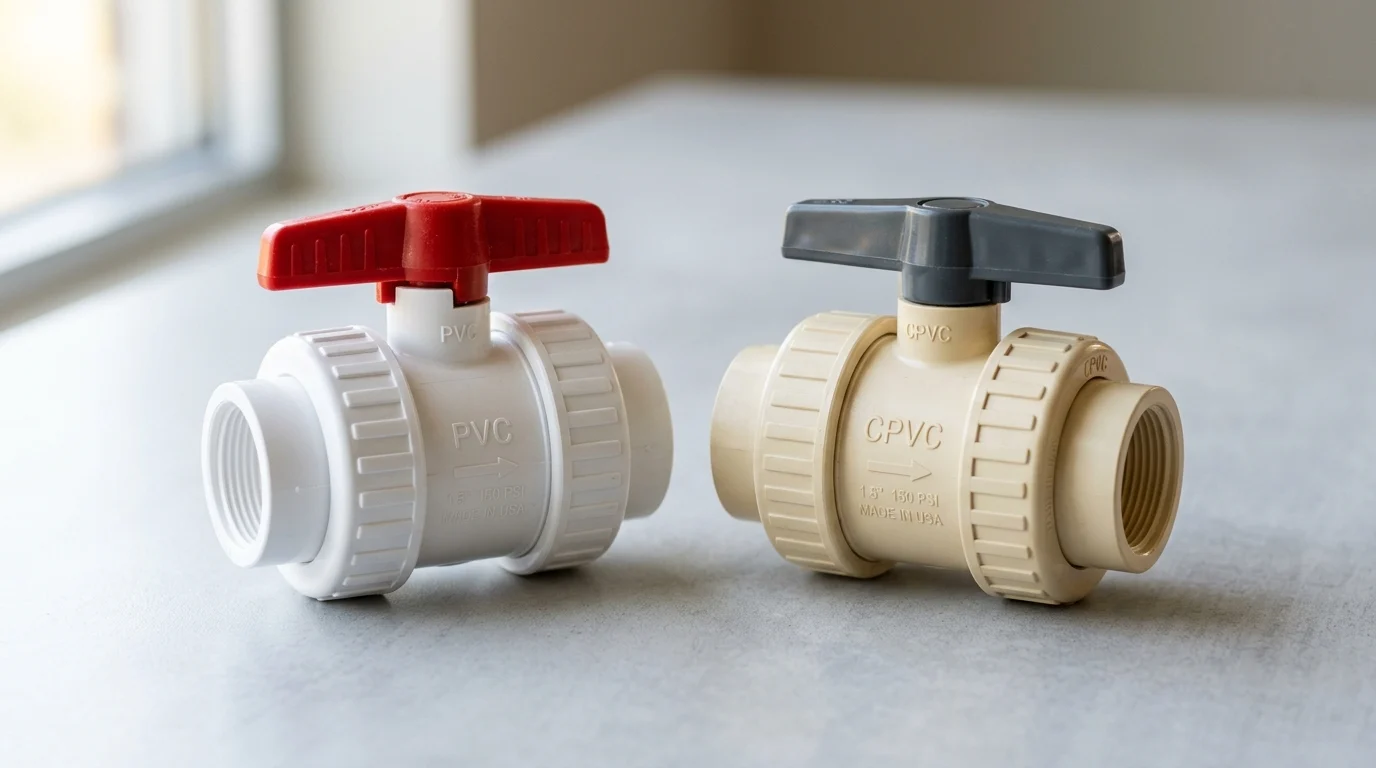
Choosing between PVC and CPVC valves affects more than material cost; it determines how a plumbing system handles heat, pressure, chemical exposure, and long-term reliability. Although both plastics resist corrosion well, they are not interchangeable in demanding commercial or industrial applications. The key differences appear when service temperatures rise, pressure ratings must be derated, or code and compatibility requirements become more stringent. This article explains how PVC and CPVC valves differ in temperature tolerance, strength, chemical performance, and typical use cases, so you can match the valve material to the operating conditions and avoid overspecifying or risking premature failure.
Why PVC vs CPVC valves matter in commercial plumbing
Selecting the correct thermoplastic valve is a critical engineering decision in commercial plumbing and industrial fluid handling. While both polyvinyl chloride (PVC) and chlorinated polyvinyl chloride (CPVC) offer exceptional corrosion resistance compared to metallic alternatives, they exhibit distinct thermodynamic and mechanical behaviors under operational stress.
Engineers and procurement specialists must navigate these differences to prevent catastrophic system failures, optimize lifecycle costs, and ensure regulatory compliance. Misunderstanding the performance boundaries of PVC vs CPVC valves frequently leads to specification errors, resulting in either unnecessary capital expenditure or premature mechanical breakdown.
Service temperature, pressure, and chemical exposure
The fundamental differentiator between PVC and CPVC valves lies in their response to elevated temperatures and pressures. Both materials base their maximum pressure ratings on an ambient temperature of 73°F (23°C). However, as fluid temperature increases, the tensile strength of both polymers decreases, requiring a strict pressure derating multiplier.
PVC valves maintain structural integrity up to a maximum service temperature of 140°F (60°C). Beyond this threshold, the material rapidly softens and loses pressure-retaining capabilities. CPVC valves, engineered for higher thermal loads, can operate effectively up to 200°F (93.3°C). In terms of chemical exposure, both materials demonstrate excellent resistance to acids, alkalis, and salts, though CPVC offers slightly broader resistance to aliphatic hydrocarbons at elevated temperatures.
Specification risk, lifecycle cost, and installation context
Specification risk is heavily tied to the installation context. Utilizing a PVC valve in a commercial domestic hot water return line—which routinely operates at 140°F to 160°F—virtually guarantees premature deformation, leakage, and potential blowout. Conversely, specifying CPVC for ambient-temperature irrigation or chilled water systems introduces unnecessary lifecycle costs.
From a capital perspective, CPVC valves typically command a 30% to 50% price premium over standard PVC equivalents, depending on valve type and diameter. This cost differential is justified in high-temperature or aggressive chemical applications where the alternative is a highly expensive specialty alloy valve. Understanding the exact thermal and pressure envelope of the installation context is the only way to balance upfront capital costs with long-term reliability.
What PVC and CPVC valves are
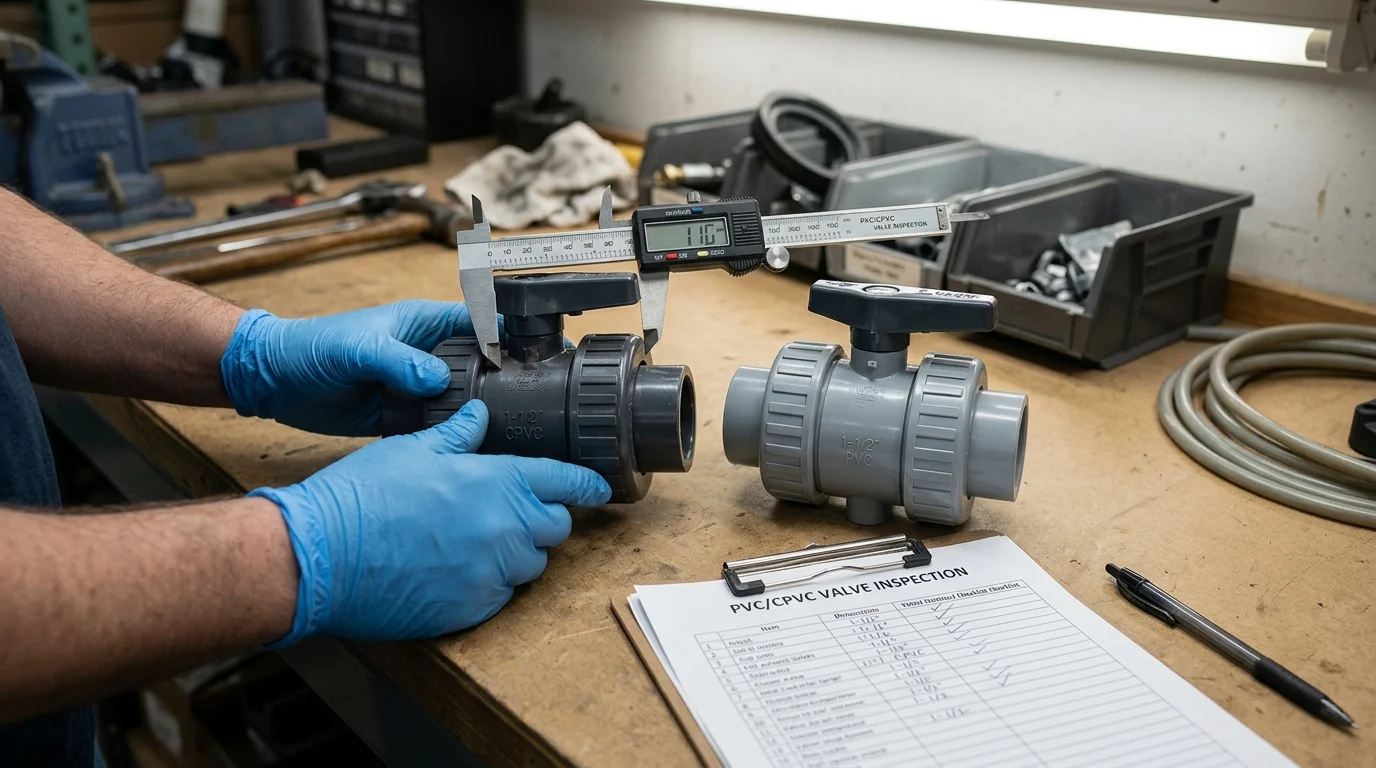
To understand how these valves perform in the field, it is necessary to examine their molecular architecture. Both PVC and CPVC belong to the vinyl polymer family, but they undergo different manufacturing processes that dictate their final physical properties and suitable applications.
Material differences and temperature limits
Standard PVC is a thermoplastic polymer synthesized from vinyl chloride monomers, containing approximately 57% chlorine by mass. CPVC is created by subjecting PVC resin to a free-radical chlorination reaction, which increases the chlorine content to a range of 63% to 74%. This additional chlorine significantly increases the polymer's glass transition temperature.
This molecular difference translates directly to temperature limits and mechanical strength. While both materials boast similar tensile strengths at room temperature (typically between 7,000 and 8,000 psi), CPVC retains a much higher percentage of its structural rigidity as temperatures climb.
| Material Property | Standard PVC | Standard CPVC |
|---|---|---|
| Max Operating Temperature | 140°F (60°C) | 200°F (93.3°C) |
| Chlorine Content | ~57% | 63% – 74% |
| Tensile Strength (at 73°F) | 7,200 psi | 8,000 psi |
| Specific Gravity | 1.41 | 1.51 |
Valve types, end connections, and common applications
Both PVC and CPVC are manufactured in a wide array of valve configurations, including true union ball valves, butterfly valves, swing check valves, and diaphragm valves. True union designs are particularly common in both materials, allowing the central valve body to be removed from the pipeline for maintenance without cutting the pipe.
End connections are standardized across both materials, offering socket (solvent weld), threaded (NPT), and flanged options. Standard PVC valves are ubiquitous in cold water distribution, agricultural irrigation, wastewater treatment, and ambient chemical dosing. CPVC valves are standard specifications for commercial domestic hot water, industrial chemical processing, and certain fire sprinkler distribution systems where metallic valves are prone to rapid scaling or corrosion.
How PVC vs CPVC valves compare
Comparing PVC vs CPVC valves requires evaluating how each material behaves dynamically within an active piping system. While they share similar installation techniques, their differing thermodynamic properties dictate strict engineering tolerances regarding thermal expansion, pressure retention, and joint integrity.
Performance, durability, and maintenance
Durability in thermoplastic valves is heavily dependent on operating within the specified pressure-temperature curve. At 73°F, a Schedule 80 PVC or CPVC true union ball valve may carry a rating of 235 psi. However, at 120°F, PVC requires a derating factor of roughly 0.40, reducing its maximum allowable pressure to just 94 psi. At the same 120°F, CPVC uses a derating factor of 0.65, maintaining a safe working pressure of 152 psi.
Maintenance protocols for both materials are minimal compared to metal valves, as neither requires lubrication or suffers from galvanic corrosion. However, CPVC's higher resistance to thermal degradation means its internal seals (typically EPDM or FKM) and seating surfaces experience less dimensional shifting during temperature cycling, resulting in a lower frequency of seat adjustments or replacements in hot water applications.
Joining methods, thermal expansion, and compatibility
Joining methods for both valves primarily rely on solvent welding, but the chemical cements are not interchangeable. PVC requires cements compliant with ASTM D2564, while CPVC requires high-temperature cements compliant with ASTM F493. Using PVC cement on a CPVC valve compromises the joint's thermal and pressure integrity.
Thermal expansion must be calculated and accommodated during installation. Thermoplastics expand significantly more than metals. CPVC has a slightly higher coefficient of thermal expansion than PVC, meaning long runs of CPVC piping connected to fixed valves require carefully engineered expansion loops to prevent severe shear stress on the valve flanges or sockets.
| Engineering Metric | PVC | CPVC |
|---|---|---|
| Coefficient of Thermal Expansion | 3.0 x 10^-5 in/in/°F | 3.4 x 10^-5 in/in/°F |
| Modulus of Elasticity (73°F) | 400,000 psi | 423,000 psi |
| Pressure Derating Factor (at 140°F) | 0.22 | 0.50 |
| Required Solvent Cement | ASTM D2564 | ASTM F493 |
Failure modes, operating limits, and field conditions
Failure modes in thermoplastic valves generally stem from improper installation or operating outside design limits. Water hammer (hydraulic shock) is a primary culprit; the surge pressure can easily exceed the derated threshold of a warm PVC valve, causing the valve body to fracture or the stem to snap.
Field conditions such as prolonged exposure to ultraviolet (UV) radiation will degrade both materials, causing embrittlement. While neither material should be exposed to direct sunlight without protective jacketing or UV-resistant paint, PVC is slightly more susceptible to rapid surface oxidation. Additionally, incompatible thread sealants containing plasticizers can cause environmental stress cracking in both PVC and CPVC threaded valve ends, representing a frequent failure mode in commercial plumbing.
Codes, certifications, and procurement factors
Commercial and industrial plumbing applications are strictly governed by building codes, material standards, and third-party certifications. Ensuring a PVC or CPVC valve meets these regulatory requirements is just as critical as verifying its mechanical specifications.
ASTM, NSF, and plumbing code requirements
The foundational standard for these materials is ASTM D1784, which establishes cell classifications based on physical properties. Standard PVC used in valves typically falls under cell class 12454, while CPVC must meet cell class 23447 or 24448. These classifications guarantee the baseline tensile strength, modulus of elasticity, and deflection temperature of the raw resin.
For potable water applications, valves must carry NSF/ANSI 14 (for plastic piping system components) and NSF/ANSI 61 (for drinking water health effects). Furthermore, to comply with the Safe Drinking Water Act, any PVC or CPVC valve utilized in domestic water distribution must meet NSF/ANSI 372 for lead-free compliance. Commercial plumbing codes, such as the Uniform Plumbing Code (UPC) and International Plumbing Code (IPC), explicitly reference these standards when dictating allowable materials for hot and cold distribution.
Sourcing quality, documentation, and traceability
Procurement specialists must evaluate supply chain reliability and quality assurance when sourcing thermoplastic valves. High-quality manufacturers operate under ISO 9001 quality management systems and provide full lot traceability stamped directly onto the valve body. This traceability is vital for isolating manufacturing defects and verifying material origin.
Lead times and Minimum Order Quantities (MOQs) vary significantly between the two materials. Standard PVC ball valves up to 4 inches in diameter are highly commoditized, rarely requiring MOQs and shipping immediately from distributor stock. Conversely, large-diameter CPVC butterfly valves (e.g., 8 to 12 inches) or specialized actuated CPVC valves often necessitate 6- to 12-week lead times and may require MOQs of 10 to 50 units depending on the manufacturer, directly impacting project schedules and procurement budgets.
How to choose between PVC and CPVC valves
Selecting the optimal valve requires a systematic approach that balances fluid dynamics, thermal parameters, and project economics. Bypassing a formal selection process often results in over-engineering, which inflates budgets, or under-engineering, which guarantees system failure.
A step-by-step selection process
The specification process must follow a strict sequence. First, determine the absolute maximum fluid temperature the system will experience, including temporary spikes. Second, identify the maximum system pressure. Third, cross-reference these two variables against the manufacturer’s specific pressure-derating curve to ensure the valve maintains a sufficient safety factor at peak temperature.
Fourth, evaluate the chemical composition of the fluid. While both materials handle water flawlessly, industrial applications involving concentrated acids, bases, or specialized chemical mixtures require consulting a chemical resistance chart specifically calibrated for PVC and CPVC. Finally, verify that the selected valve body and its internal elastomer seals (EPDM, FKM, or PTFE) meet all local code and NSF certification requirements for the intended application.
When PVC is the better choice
PVC is the definitive choice for cold and ambient temperature fluid handling. If a commercial system operates consistently below 100°F (37.7°C) and handles compatible fluids, specifying CPVC offers zero mechanical advantage and simply wastes capital. PVC valves are ideal for chilled water lines, municipal water mains, agricultural irrigation networks, swimming pool filtration systems, and ambient-temperature wastewater handling.
Because of its lower raw material cost and highly efficient manufacturing scale, PVC provides exceptional value. It allows facilities to implement corrosion-resistant, high-flow fluid distribution networks at a fraction of the cost of both metallic and high-temperature thermoplastic alternatives.
When CPVC is the better choice
CPVC becomes mandatory when system temperatures exceed 130°F (54.4°C) or when handling specific corrosive industrial chemicals that degrade standard PVC. It is the industry standard thermoplastic for commercial domestic hot water distribution, hydronic heating return lines, and high-temperature chemical processing.
Additionally, CPVC is often the better choice in environments with strict fire safety and smoke spread regulations. CPVC possesses a Limiting Oxygen Index (LOI) of 60%, meaning it requires an atmosphere of 60% oxygen to sustain a flame, compared to PVC's LOI of 43%. This superior flame retardance and lower smoke generation profile allow CPVC valves and piping to be utilized in light-hazard fire sprinkler systems and specific return-air plenums where standard PVC is strictly prohibited by fire codes.
Key Takeaways
- The most important conclusions and rationale for PVC vs CPVC valves
- Specs, compliance, and risk checks worth validating before you commit
- Practical next steps and caveats readers can apply immediately
Frequently Asked Questions
What is the main difference between PVC and CPVC valves?
The key difference is heat tolerance. PVC valves are typically used up to 140°F (60°C), while CPVC valves can handle up to 200°F (93.3°C), making CPVC better for hot water and higher-temperature chemical service.
When should I choose a PVC valve instead of a CPVC valve?
Choose PVC for ambient-temperature systems like irrigation, cold water supply, wastewater, and many underground lines. It usually costs less and performs well when heat is not a factor.
Are CPVC valves worth the higher price?
Yes, if your system carries hot water or elevated-temperature chemicals. CPVC often costs 30% to 50% more, but it helps avoid deformation, leaks, and early valve failure in high-temperature service.
Can PVC and CPVC valves use the same connection types?
Yes. Both are commonly available with socket, threaded, and flanged ends, and in types like ball, check, and butterfly valves. Always confirm size, pressure rating, and application before ordering.
Which valve material is better for irrigation or commercial plumbing projects?
For irrigation and cold water projects, PVC is usually the practical choice. For commercial hot water lines or hotter chemical systems, CPVC is safer. Pntek can help match valves with compatible pipes and fittings for the full system.


