
Introduction
Choosing between threaded and socket PVC fittings affects far more than assembly preference. The connection type influences leak resistance, pressure performance, maintenance access, and how easily a system can be modified or repaired later. This article focuses on threaded PVC fittings while comparing them with solvent-weld socket options, so readers can understand where each method performs best and where it introduces risk. You will learn the practical differences in sealing method, installation process, serviceability, and typical use cases, making it easier to specify the right fitting for water pipe installations with fewer failures and less rework.
What are threaded and socket PVC fittings
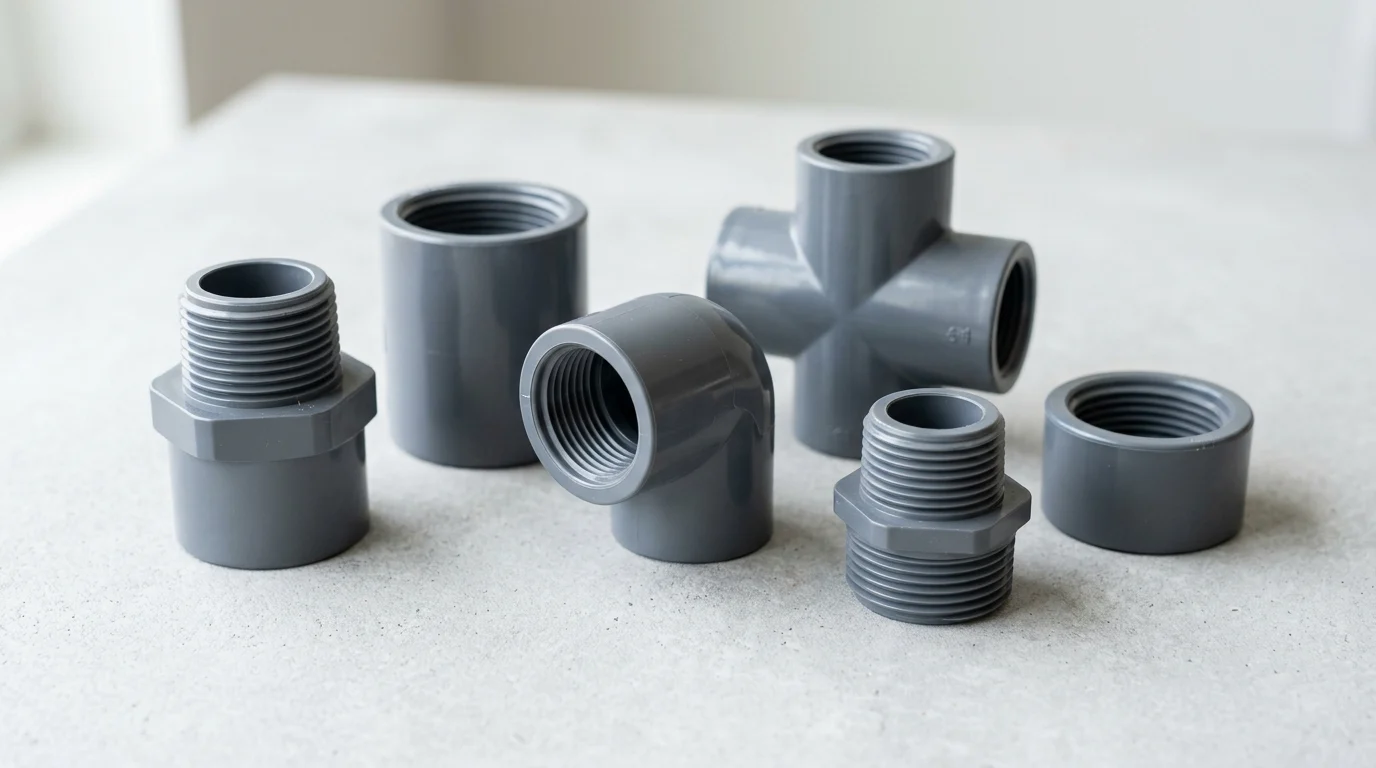
Polyvinyl chloride (PVC) piping networks rely heavily on the integrity of their connections to maintain system pressure and prevent fluid loss. In industrial, municipal, and commercial fluid handling, engineers and contractors primarily utilize two distinct connection methodologies: threaded fittings and solvent-weld socket fittings. While both are manufactured from the same base thermoplastic resin, their mechanical characteristics, installation procedures, and long-term performance profiles differ significantly.
Selecting the correct fitting architecture dictates not only the initial installation velocity but also the lifecycle serviceability of the piping infrastructure. An incorrect specification can lead to catastrophic joint failure, accelerated fatigue under pressure transients, or excessive downtime during routine component maintenance.
How do threaded fittings differ from solvent-weld socket fittings?
Threaded PVC fittings utilize a mechanical interference fit to achieve a seal, predominantly employing National Pipe Thread Taper (NPT) or British Standard Pipe Taper (BSPT) geometries. As the male and female threads are engaged, the taper forces the flanks of the threads together, creating a tortuous path for the fluid. In contrast, solvent-weld socket fittings rely on a chemical fusion process. A solvent cement, typically containing tetrahydrofuran (THF) and methyl ethyl ketone (MEK), softens the surface of the PVC pipe and the fitting socket. Upon insertion, the two softened layers intermingle and cure, effectively forming a single, continuous piece of plastic.
Because socket joints fuse the material, they eliminate the mechanical stress concentrations inherent in cut or molded threads. Threaded joints, however, retain their mechanical independence, requiring a supplementary sealing medium, such as PTFE tape or a compatible non-hardening thread sealant, to fill the microscopic voids between the thread crests and roots.
What pressure, temperature, and material limits apply?
Standard PVC (Type I, Grade I) is universally restricted to a maximum operating temperature of 140°F (60°C). However, the pressure capacities of threaded and socket fittings diverge sharply. Industry standards mandate that threading a PVC pipe or utilizing a threaded PVC fitting automatically reduces the maximum working pressure rating of the system by 50% compared to a solvent-welded system of the same schedule and diameter.
For example, a 2-inch Schedule 80 PVC pipe with solvent-welded socket fittings may carry a maximum working pressure of 400 PSI at 73°F (23°C). If threaded fittings are introduced into that same 2-inch line, the maximum allowable pressure drops to 200 PSI. Furthermore, standard Schedule 40 PVC pipe should never be threaded due to insufficient wall thickness, meaning threaded connections are practically restricted to Schedule 80 or heavier materials.
Which fitting types are most relevant in this comparison?
The most critical fitting types in this comparative analysis are those that dictate system modularity. Adapters (specifically male adapters, or MIP, and female adapters, or FIP) are the primary transition components used to bridge solvent-welded pipe sections with threaded mechanical equipment. Unions, which combine a threaded locking nut with either socket or threaded ends, represent the ultimate hybrid component for serviceability.
Additionally, standard directional and branching fittings—such as 90-degree elbows, 45-degree elbows, and tees—are available in fully socketed, fully threaded, and mixed configurations. Mixed configuration tees (e.g., socket run with a threaded branch) are highly relevant when designing sensor integration points or sample taps within a rigid solvent-welded distribution manifold.
How do threaded PVC fittings compare with socket fittings
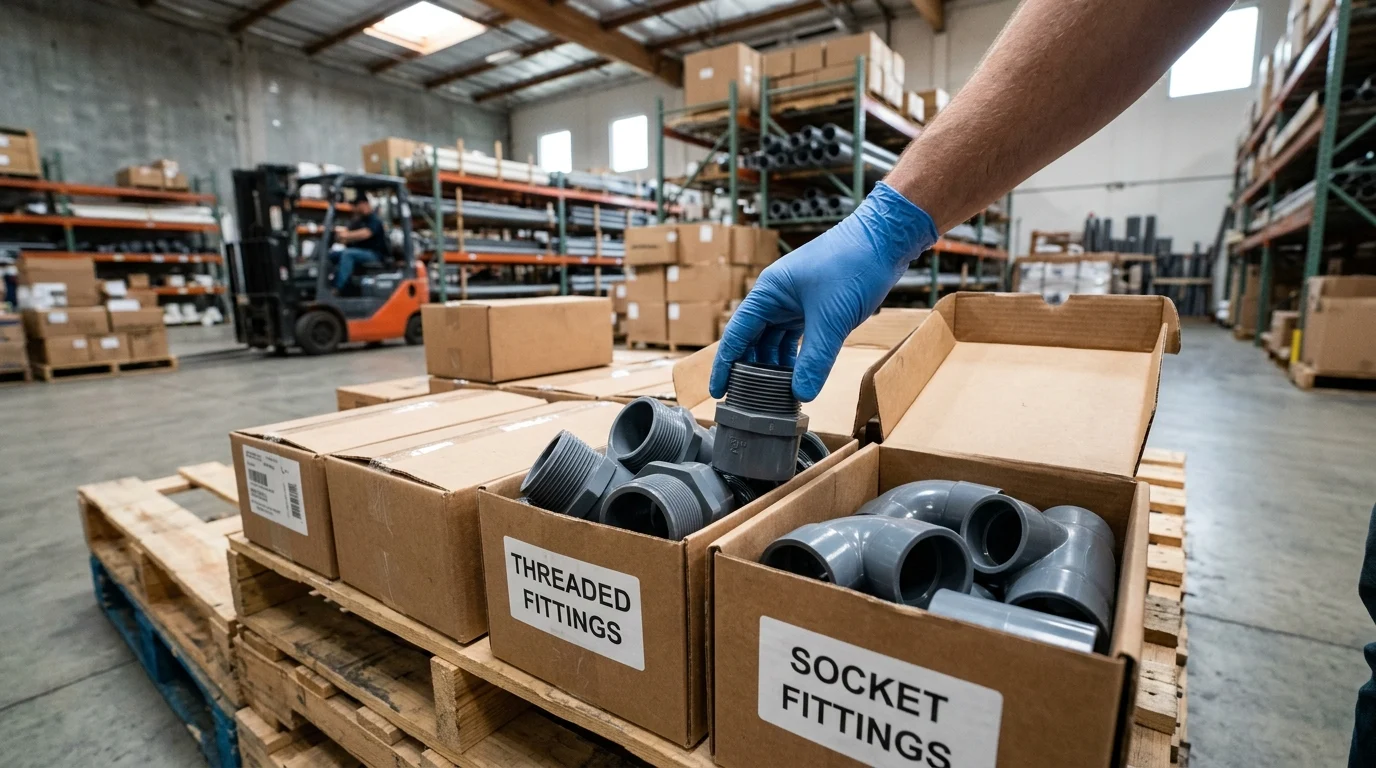
Evaluating threaded versus socket PVC fittings requires a granular look at the mechanics of the joint under operational stress. The choice between chemical fusion and mechanical engagement alters how a piping network responds to internal pressure, external environmental forces, and routine maintenance protocols.
How do sealing methods, installation, and reliability differ?
Sealing a socket fitting requires specific ambient conditions and chemical preparation. Installers must apply a primer to dissolve the surface glaze, followed by the correct viscosity cement (medium or heavy body, depending on pipe diameter). Once cured—often requiring 24 hours to achieve full pressure rating—the joint boasts near-zero failure rates under static loads. However, the installation is highly susceptible to human error during the chemical application phase, such as insufficient primer or improper insertion depth.
Threaded fittings bypass chemical curing times, offering immediate pressurization capabilities. Installation relies on applying 2 to 3 wraps of high-density PTFE tape or a compatible liquid sealant. While installation is less sensitive to ambient humidity or temperature, threaded joints possess a lower baseline reliability for high-pressure fluids. Over-tightening can easily fracture the female PVC threads, while under-tightening results in spiral leak paths.
How do maintenance, disassembly, and lifecycle cost compare?
| Feature | Threaded PVC Fittings | Socket (Solvent-Weld) Fittings |
|---|---|---|
| Sealing Mechanism | Mechanical interference + PTFE/sealant | Chemical fusion (primer + cement) |
| Pressure Derating | 50% reduction from base pipe rating | 0% reduction (maintains pipe rating) |
| Cure Time to Test | Immediate | Up to 24+ hours (size/temp dependent) |
| Disassembly | Non-destructive (unscrew) | Destructive (cut and replace) |
| Reusability | High (if threads are undamaged) | Zero (permanent joint) |
Lifecycle costs heavily favor threaded fittings in dynamic environments where equipment requires frequent calibration, repair, or replacement. Because threaded joints can be disassembled non-destructively, maintenance personnel can isolate and remove a failed pump or valve without severing the piping infrastructure. Conversely, socket fittings are permanent. Replacing a solvent-welded component requires cutting the pipe, discarding the fitting, and utilizing slip couplings to integrate a new segment, which increases labor costs and material waste over a 20-year facility lifecycle.
How do vibration, thermal movement, and confined spaces affect selection?
Environmental and mechanical stressors drastically impact fitting selection. PVC has a relatively high coefficient of thermal expansion—approximately 3.0 × 10⁻⁵ in/in/°F. In systems experiencing significant temperature swings, thermal cycling can cause threaded joints to micro-shift, gradually backing out and inducing leaks. Solvent-welded socket joints, acting as a single monolithic structure, absorb thermal expansion and contraction much more effectively without compromising the seal.
Similarly, high-frequency vibration from centrifugal pumps or compressors is detrimental to threaded PVC connections, often causing fatigue failure at the thread root or loosening the joint over time. Socket fittings are vastly superior in high-vibration zones. However, in confined spaces where the emission of volatile organic compounds (VOCs) from solvent cements poses an asphyxiation or flammability hazard, mechanical threaded fittings provide a safer, fume-free installation alternative.
Where are threaded vs socket PVC fittings best used
The optimal deployment of threaded and socket PVC fittings is dictated by the specific zone within the fluid handling system. Engineers typically segment piping networks into permanent distribution infrastructure and serviceable equipment nodes, assigning fitting types accordingly.
Where are threaded PVC fittings most often specified?
Threaded PVC fittings are universally specified at equipment interfaces. Instrumentation points involving pressure transducers, pH sensors, and flow meters almost exclusively rely on threaded female fittings to allow for periodic sensor removal and calibration. Similarly, connections to mechanical equipment such as chemical dosing pumps, filtration canisters, and actuated valves heavily utilize threaded adapters.
Furthermore, threaded fittings are the standard solution for material transitions. When a PVC network must interface with existing stainless steel, brass, or galvanized steel piping, threaded connections—specifically utilizing a male PVC threaded adapter into a female metal thread to prevent expansion fracturing—are the mandated engineering practice.
When are socket fittings the better choice?
Socket fittings are the undisputed choice for main fluid distribution backbones. In buried municipal water lines, agricultural irrigation mains, and long-run industrial chemical transport, the permanence and structural integrity of solvent-welded joints are non-negotiable. Buried applications, which are entirely inaccessible without costly excavation, demand the zero-leak, zero-maintenance profile of a fused socket joint.
Additionally, high-pressure networks operating near the maximum threshold of the PVC schedule—such as a 150 PSI cooling water loop—must utilize socket fittings to avoid the 50% pressure derating penalty associated with threaded connections. Systems handling aggressive, penetrating chemicals also favor socket joints, as threaded sealants can degrade when exposed to certain solvents or concentrated acids.
How do project risk and maintenance access influence selection?
Project risk profiles directly shape the fitting specification. In mission-critical environments like semiconductor manufacturing or pharmaceutical cleanrooms, where a micro-leak could result in millions of dollars in contaminated product, engineers minimize risk by maximizing the use of socket fittings and minimizing threaded connections to absolute necessities.
Conversely, maintenance access defines the physical layout. If a pipe run is installed behind a permanent bulkhead or within a concrete trench, socket fittings are mandatory. If the fitting is located on an accessible skid, overhead rack, or service panel where technicians have 360-degree wrench access, threaded fittings are introduced strategically to isolate high-wear components and reduce future maintenance downtime.
What compliance and quality factors should buyers review
Industrial buyers and procurement managers must look beyond basic dimensions when sourcing PVC fittings. Ensuring long-term reliability requires rigorous validation of manufacturing standards, dimensional tolerances, and supplier quality control protocols.
Which standards, pressure classes, and certifications matter?
| Standard | Specification Focus | Primary Application |
|---|---|---|
| ASTM D2466 | Poly(Vinyl Chloride) (PVC) Plastic Pipe Fittings, Schedule 40 | Low-pressure socket fittings |
| ASTM D2467 | Poly(Vinyl Chloride) (PVC) Plastic Pipe Fittings, Schedule 80 | High-pressure socket fittings |
| ASTM D2464 | Threaded Poly(Vinyl Chloride) (PVC) Plastic Pipe Fittings, Sch 80 | High-pressure threaded fittings |
| NSF/ANSI 61 | Drinking Water System Components – Health Effects | Potable water safety verification |
| NSF/ANSI 14 | Plastics Piping System Components and Related Materials | Physical/performance testing |
Compliance with ASTM standards guarantees that the fittings meet baseline burst pressure, material composition, and dimensional requirements. For any application involving human consumption, NSF/ANSI 61 certification is legally mandated in North America to ensure lead-free and non-toxic formulation. Buyers must verify that these certifications are stamped directly onto the fitting body, not merely claimed in vendor literature.
How do thread quality, tolerances, and molding consistency affect performance?
The performance of a threaded PVC fitting is highly dependent on injection molding precision. NPT threads require a precise taper of 3/4 inch per foot to ensure proper flank engagement. Inferior manufacturing can result in “flat” crests, poor taper angles, or prominent parting lines (flashing) across the threads. A parting line defect acts as a direct channel for high-pressure fluid to bypass the PTFE tape, resulting in a persistent spiral leak.
For socket fittings, the internal diameter tolerances are equally critical. A socket that is molded too large will result in a “loose fit,” preventing the solvent cement from generating sufficient hydrostatic pressure to fuse the materials. Buyers should require statistical process control (SPC) data from manufacturers to verify that dimensional tolerances hold within a strict ±0.005 inch variance during high-volume production runs.
How do sourcing, lead times, and supplier support influence buying decisions?
Supplier reliability heavily influences total project cost. For large-scale industrial projects or OEM manufacturing, buyers typically negotiate bulk procurement. Minimum Order Quantities (MOQs) for custom or high-grade schedule 80 fittings can frequently exceed 5,000 pieces. Evaluating a supplier’s Acceptable Quality Limit (AQL) is vital; a world-class supplier should guarantee an AQL of 0.65 for critical dimensional defects, whereas an AQL of 1.5 or 2.5 may result in unacceptable failure rates in the field.
Lead times also dictate sourcing strategy. While standard schedule 40 socket fittings are generally available off-the-shelf, specialty schedule 80 threaded transition fittings or large-diameter components may carry lead times of 4 to 6 weeks. Buyers must partner with suppliers who maintain adequate domestic inventory buffers to prevent costly project delays.
How should specifiers and contractors choose between them
Bridging the gap between engineering theory and field execution requires specifiers and contractors to adopt a systematic approach to fitting selection and installation. Proper decision-making at the design phase mitigates the majority of operational failures.
What decision criteria help match fitting type to the application?
Specifiers should utilize a clear decision matrix based on three primary criteria: system pressure, environmental dynamics, and serviceability requirements.
Key Takeaways
- The most important conclusions and rationale for threaded PVC fittings
- Specs, compliance, and risk checks worth validating before you commit
- Practical next steps and caveats readers can apply immediately
Frequently Asked Questions
When should I choose threaded PVC fittings instead of socket fittings?
Use threaded PVC fittings where equipment may need removal, such as valves, meters, filters, or pump connections. For permanent straight runs, socket fittings are usually stronger and more leak-resistant.
Do threaded PVC fittings reduce pressure capacity?
Yes. Adding threaded PVC fittings typically cuts the working pressure rating by about 50% versus a comparable solvent-welded system. Always confirm schedule, size, and operating temperature before specifying.
Can Schedule 40 PVC pipe be threaded?
No. Standard Schedule 40 PVC pipe should not be threaded because the wall is too thin. Threaded connections are generally limited to Schedule 80 PVC or heavier materials.
What sealant should be used on threaded PVC fittings?
Use PTFE tape or a PVC-compatible non-hardening thread sealant. Avoid over-tightening, because plastic threads can crack if excessive force is applied during assembly.
Can Pntek help match threaded fittings with valves and water systems?
Yes. Pntek supplies PVC fittings, valves, water meters, and related piping products, so buyers can request coordinated connection types for irrigation, construction, and water supply projects.


