Agricultural irrigation accounts for approximately 70% of global freshwater withdrawals, according to the Food and Agriculture Organization (FAO). Selecting the correct piping material directly affects water delivery efficiency, system longevity, and long-term maintenance costs. For large-scale agricultural operations, an ill-fitted pipe system can result in pressure losses exceeding 20–30%, leaks, and premature failure—translating to thousands of dollars in crop losses and repair bills annually.
This guide examines how agricultural decision-makers—from farm managers to irrigation engineers—can systematically evaluate pipe materials, sizing requirements, and system designs to maximize performance and return on investment.
What Are the Primary PVC Pipe Types Used in Agricultural Irrigation?
Agricultural irrigation systems predominantly use four types of plastic pipes, each with distinct chemical compositions, pressure ratings, and application ranges.
UPVC (Unplasticized Polyvinyl Chloride) is the most widely used pipe material in gravity-fed and low-to-medium pressure irrigation systems. UPVC pipes offer a maximum operating pressure of 6–15 bar (depending on diameter and wall thickness) and are resistant to corrosion, chemical fertilizers, and UV degradation when properly stabilized. The pipe’s smooth internal surface (Hazen-Williams roughness coefficient of approximately C=150) minimizes friction losses and supports consistent flow rates over long distances.
CPVC (Chlorinated Polyvinyl Chloride) contains additional chlorine content, raising its maximum service temperature to 95°C and improving its resistance to chlorine-based disinfectants. CPVC is preferred in systems where water needs to be treated or where temperature fluctuations are more extreme.
PPR (Polypropylene Random Copolymer) operates effectively across a temperature range of −10°C to +95°C and offers superior joint strength through heat fusion welding, making it suitable for subsurface irrigation installations where joint reliability is critical.
HDPE (High-Density Polyvinyl Chloride) provides exceptional flexibility and impact resistance at temperatures as low as −40°C, making it the preferred choice for cold-climate agricultural regions and rough-terrain installations where pipe bending around obstacles is required.
Key Characteristics Comparison
| Property | UPVC | CPVC | PPR | HDPE |
|---|---|---|---|---|
|
Max Pressure (bar) |
6–15 |
6–20 |
6–25 |
6–16 |
|
Max Temperature (°C) |
60 |
95 |
95 |
60 |
|
Flexibility |
Rigid |
Rigid |
Semi-rigid |
Flexible |
|
Joint Method |
Solvent cement / Threaded |
Solvent cement / Threaded |
Heat fusion |
Electrofusion / Mechanical |
|
UV Resistance |
Moderate (with stabilizers) |
Moderate |
Low |
High (with carbon black) |
How Does Pipe Sizing Affect Irrigation System Efficiency?
Improper pipe sizing is among the most common causes of irrigation system failure. Undersized pipes create excessive friction losses, reducing water pressure at the point of delivery and causing uneven crop coverage. Oversized pipes increase material costs without proportional performance benefits and can slow water velocity to levels that allow sediment settling and biological growth.
Step-by-Step Pipe Sizing Process
The process for correctly sizing irrigation pipes follows a four-step calculation:
1.Determine total flow rate (Q): Sum the flow requirements of all emitters, sprinklers, or outlets in the system. Express flow in liters per second (L/s) or gallons per minute (GPM).
2.Calculate maximum allowable friction loss: Subtract the minimum required pressure at the furthest outlet from the source pressure. Industry guidelines recommend limiting friction loss to 10–15% of total dynamic head.
3.Select trial pipe diameter: Using the Hazen-Williams or Darcy-Weisbach equation, calculate the friction loss for candidate pipe diameters. Tables from the American Society of Agricultural Engineers (ASAE) provide pre-calculated values for common pipe sizes and flow rates.
4.Verify velocity constraints: Ensure water velocity remains below 2.3 m/s (7.5 ft/s) in pressurized systems to prevent water hammer and pipe wall erosion. For gravity-fed systems, a minimum velocity of 0.6 m/s prevents sediment deposition.
For a typical 10-hectare center-pivot irrigation system delivering 200 L/s, a main line of 250–300 mm diameter UPVC pipe maintains velocity within acceptable ranges while minimizing friction losses to under 0.5 m per 100 m of pipe length.
What Installation Practices Ensure Long-Term Reliability of PVC Irrigation Pipes?
Installation quality determines whether a PVC irrigation system lasts 25–50 years or fails within 5–10 years. The following practices are critical for maximizing system reliability.
Proper Handling and Storage
PVC pipes must be stored on flat, shaded surfaces away from direct sunlight, which can cause UV degradation of the outer surface. Pipes should be supported along their full length during storage to prevent ovality—the deformation of the pipe cross-section, which compromises joint integrity.
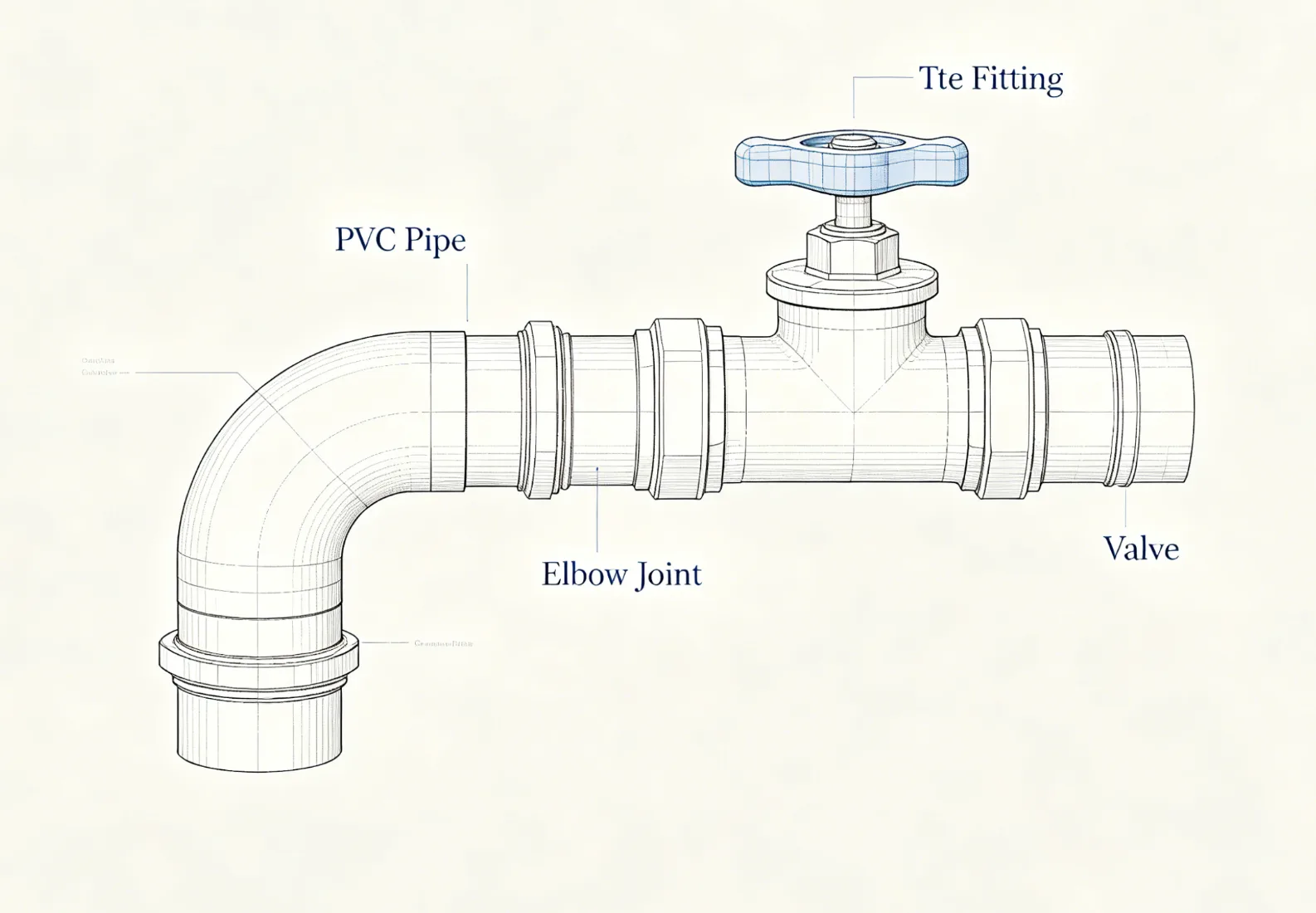
Joint Preparation and Assembly
Solvent-cemented joints require meticulous surface preparation:
1.Cut the pipe square using a wheel-type pipe cutter or fine-tooth saw.
2.Remove all burrs from the pipe end and the interior of the fitting socket.
3.Clean both surfaces with PVC primer to remove surface gloss and contamination.
4.Apply solvent cement evenly to both the pipe exterior and fitting interior.
5.Assemble immediately and hold for 30 seconds without disturbance.
The International Plumbing Code (IPC) specifies that the cement application temperature should be above 4°C (40°F) and below 38°C (100°F) for optimal joint curing.
Burial and Backfill Requirements
For subsurface irrigation lines, pipes should be buried at a minimum depth of 30–60 cm below the frost line to prevent freeze damage. Backfill material should be free from sharp rocks and debris, with initial backfill placed in layers of 15 cm followed by mechanical compaction.
How Do Environmental Factors Influence PVC Pipe Performance in Agriculture?
Agricultural environments present unique challenges including chemical exposure, temperature cycling, mechanical loading from farm equipment, and soil chemistry variations.
Chemical Resistance
PVC pipes exhibit strong resistance to most agricultural chemicals including ammonia-based fertilizers, phosphoric acid solutions, and calcium nitrate. However, exposure to aromatic hydrocarbons (such as benzene or toluene), ketones, and Esters can cause solvent stress cracking. A chemical resistance chart from the Pvcpipe.org provides a comprehensive compatibility reference for specific chemical concentrations and temperatures.
UV Exposure
Outdoor installations expose PVC pipes to prolonged UV radiation, which causes surface chalking and gradual embrittlement. UV-resistant formulations incorporating titanium dioxide or carbon black additives extend service life by 10–15 years in exposed installations. For above-ground applications in high-altitude regions, consider HDPE with 2–3% carbon black content, which provides superior UV screening compared to standard PVC formulations.
Soil Load and Mechanical Stress
Agricultural fields experience significant dynamic loads from tractors and harvesting equipment. Pipes installed beneath farm lanes should be buried at depths exceeding 90 cm or protected by concrete encasement to distribute point loads and prevent pipe deformation or fracture.
What Are the Cost Considerations When Selecting PVC Pipes for Large-Scale Irrigation?
Total system cost comprises three components: initial material cost (typically 40–50% of total), installation labor cost (approximately 30–35%), and long-term maintenance cost (approximately 15–25% over a 20-year lifecycle).
UPVC pipes offer the lowest material cost per meter among all plastic pipe options—approximately 20–40% less than comparable HDPE or PPR systems. However, HDPE’s superior flexibility can reduce installation costs in rocky or uneven terrain where UPVC’s rigidity would require additional fittings.
Life-cycle cost analysis should incorporate projected replacement costs, energy costs for pumping (influenced directly by pipe roughness and resulting friction losses), and expected system downtime. According to Irrigation Australia, a properly designed UPVC irrigation system achieves a payback period of 3–7 years compared to open-channel irrigation, with ongoing water savings of 15–30%.
Frequently Asked Questions (FAQ)
What is the expected service life of UPVC pipes in agricultural irrigation systems?
UPVC pipes installed following manufacturer guidelines and within specified pressure ratings have an expected service life of 25–50 years. The actual lifespan depends on operating pressure relative to rated pressure, chemical exposure, UV exposure levels, and mechanical loading. Regular visual inspection every 12–24 months is recommended to identify surface degradation, joint seepage, or deformation before failures occur.
Can PVC pipes be used for both above-ground and buried irrigation installations?
Yes. UPVC and HDPE pipes are suitable for both above-ground and buried installations, with material selection depending on specific site conditions. Above-ground installations require UV-resistant formulations and proper support spacing (typically 1.0–1.5 m between supports for 110 mm diameter pipes). Buried installations require consideration of burial depth, backfill conditions, and groundwater exposure. CPVC is generally preferred for above-ground applications requiring higher temperature resistance.
How do I prevent water hammer in PVC irrigation systems?
Water hammer occurs when sudden valve closures cause pressure surges that can exceed 2–3 times the normal operating pressure. Prevention strategies include: installing slow-closing valves (closing time exceeding 70% of the water hammer wave travel time), incorporating air chambers or pressure surge tanks at system high points, using pneumatically operated valves, and avoiding pump shutdown sequences that create vacuum conditions. Pipes with thicker walls (Schedule 40 or higher) also provide greater resistance to transient pressure events.
What diameter pipe is required for a 5-hectare drip irrigation system?
For a 5-hectare drip irrigation system with a total flow rate of 50 L/min (0.83 L/s), a main line of 50–63 mm diameter UPVC pipe is typically sufficient for runs up to 200 meters. Submains of 32–40 mm diameter feed individual drip zones. Exact sizing should be validated using friction loss calculations specific to the site’s elevation profile and emitter pressure requirements. Consulting the FAO’s irrigation design guidelines or working with a certified irrigation designer is recommended for systems exceeding 3 hectares.
Are PVC pipes environmentally safe for drinking water irrigation in food production?
UPVC and CPVC pipes are certified for contact with potable water by multiple international standards including NSF/ANSI 61 (Drinking Water System Components) in North America and WRAS (Water Regulations Advisory Scheme) in the United Kingdom. For food crop irrigation, PVC pipes are considered safe when used within rated temperature and pressure specifications. However, for crops where irrigation water contacts the edible portion directly, some certification schemes require specific pipe formulations. Always verify product certification with the manufacturer before specifying pipe materials for food-production irrigation applications.