What Are Sprinkler System Pipes and Fittings in Agricultural Irrigation?
Agricultural irrigation consumes approximately 70% of global freshwater withdrawals, according to the Food and Agriculture Organization (FAO). Irrigated farmland covers roughly 20% of the world’s cultivated area but produces 40% of total food output, making irrigation efficiency a direct driver of farm profitability and food security.
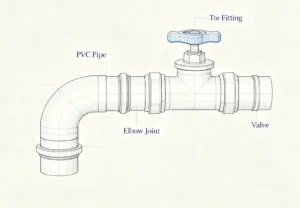
A sprinkler irrigation system replicates natural rainfall by distributing water through a pressurized network of pipes and fittings. This network typically consists of three components: main lines (which carry water from the water source), sub-main lines (which distribute water across zones), and lateral lines (which feed individual sprinklers). Fittings—including elbows, tees, reducers, couplers, and valves—connect these pipes and control water flow direction, pressure, and volume.
Choosing the correct pipes and fittings directly impacts water distribution uniformity, system pressure consistency, and long-term maintenance costs. Inappropriate material selection or incorrect pipe sizing can reduce sprinkler throw distance, cause dry spots in the field, and increase energy consumption due to excessive pressure losses.
Key takeaway: Sprinkler irrigation pipes and fittings form the hydraulic backbone of the system. Material and sizing errors at the design stage compound into operational inefficiencies that are expensive to correct after installation.
Which Pipe Material Is Best for Sprinkler Irrigation Systems?
Three materials dominate agricultural sprinkler irrigation: HDPE (High-Density Polyethylene), UPVC (Unplasticized Polyvinyl Chloride), and PPR (Polypropylene Random Copolymer). Each offers distinct performance characteristics suited to different application requirements.
HDPE Pipe Fittings for Irrigation
HDPE pipes are widely regarded as the premium choice for agricultural irrigation main lines and sub-mains. HDPE offers exceptional flexibility, enabling it to absorb ground movement without cracking—a critical advantage in soils subject to seasonal freeze-thaw cycles or settlement. HDPE fittings are joined primarily through butt fusion or electrofusion, creating a monolithic, leak-free joint that eliminates gaskets as potential failure points.
HDPE exhibits strong chemical resistance to acids, alkalis, and the fertilizers commonly applied through irrigation systems. HDPE pipes are manufactured to ISO 4427-2 and EN 12201 standards, with pressure ratings typically ranging from PN6 to PN25. The material tolerates operating temperatures from -40°C to +60°C, making it suitable for both temperate and subtropical climates.
HDPE pipes are lightweight—approximately 8% the weight of steel—which reduces transportation costs and enables faster installation. The pipes also demonstrate superior abrasion resistance against sand and sediment-laden water, a common condition in surface water irrigation sources.
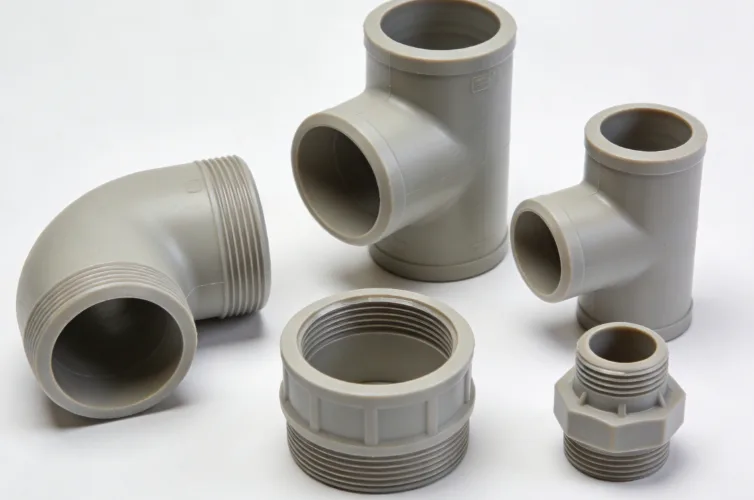
UPVC Pipes and Fittings for Irrigation
UPVC pipes are the most common choice for sprinkler lateral lines and medium-pressure applications. UPVC offers the highest pressure-to-cost ratio among the three materials and is manufactured to ISO 16022 and various national standards including AS/NZS 1477 (Australia/New Zealand) and NMX-E-164 (Mexico).
UPVC pipes provide excellent resistance to corrosion and scale buildup, maintaining smooth internal walls throughout their service life. This smooth bore optimizes flow characteristics and minimizes pressure losses. UPVC fittings are joined using solvent cement or threaded connections, enabling rapid assembly with standard hand tools.
The material’s rigidity makes UPVC suitable for above-ground installations where pipe support spacing can be maintained. UPVC tolerates continuous operating temperatures up to 60°C and intermittent temperatures to 80°C. UPVC demonstrates excellent performance in neutral to slightly acidic water conditions commonly found in agricultural applications.
PPR Pipes for Irrigation
PPR pipes serve effectively in cold-water distribution lines feeding sprinkler systems and in regions where ambient temperatures rarely exceed 45°C. PPR offers good chemical resistance and is particularly suited to systems using fertigation (fertilizer injection through irrigation), as the material resists internal scaling.
PPR joints are made through socket fusion, producing strong, homogeneous connections. The material offers moderate flexibility and requires more support than HDPE in above-ground applications. PPR pressure ratings typically max out at PN20, making it better suited to lateral line applications than high-pressure main lines.
Material Comparison Table
| Property | HDPE | UPVC | PPR |
|---|---|---|---|
| Max Pressure Rating | PN6–PN25 | PN6–PN20 | PN6–PN20 |
| Max Operating Temp | 60°C | 60°C | 60°C (95°C intermittent) |
| Flexibility | High | Low | Moderate |
| Joint Method | Butt fusion / Electrofusion | Solvent cement / Threaded | Socket fusion |
| Expected Lifespan | 50–100 years | 30–50 years | 25–30 years |
| Chemical Resistance | Excellent | Good | Good |
| Weight | Light (8% of steel) | Moderate | Light |
| Best For | Main lines, sub-mains, harsh environments | Lateral lines, above-ground | Cold-water laterals, fertigation |
Key takeaway: For most agricultural sprinkler systems, HDPE is the recommended choice for main lines and sub-mains due to its durability, joint integrity, and flexibility. UPVC serves well for lateral lines where rigidity and cost efficiency are priorities. PPR is suitable for cold-water supply lines feeding the sprinkler network.
What Types of Fittings and Valves Does a Sprinkler Irrigation System Need?
A complete sprinkler irrigation system requires a combination of connection fittings and control valves to direct water flow, isolate sections for maintenance, and regulate pressure.
Essential Fittings
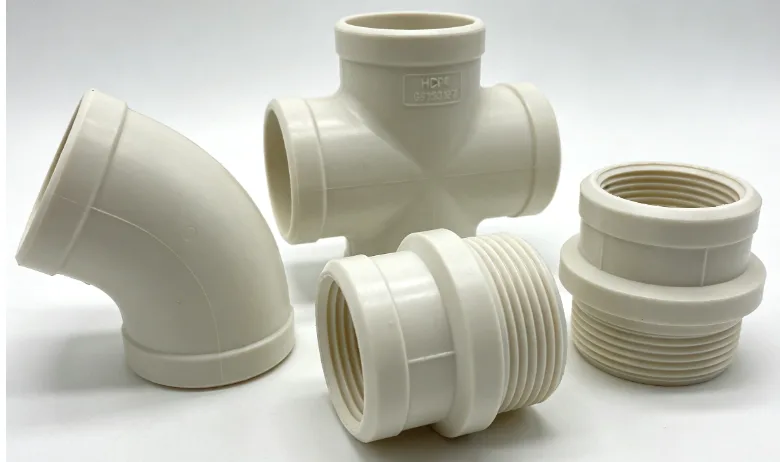
- Elbow fittings (90° and 45°) — Change water flow direction at bends in the pipe run.
- Tee fittings — Split water flow into two directions at branch points.
- Reducer fittings — Transition between different pipe diameters (e.g., DN80 to DN50).
- Coupling/socket fittings — Join two pipe sections in a straight run.
- End caps — Seal the terminal end of a pipe run.
- Te saddle and clamp fittings — Create branch connections on existing main lines without disrupting flow.
Fittings must match the pipe material and pressure rating. HDPE fittings are typically fusion-compatible with HDPE pipes. UPVC fittings are joined using solvent cement per ASTM D 3139 or threaded connections per ASTM F 1974.
Essential Valves
- Ball valves — Provide reliable on/off isolation for individual zones or sections. Popular types include PVC True Union Ball Valve (which allows inline maintenance without removing the valve from the pipeline) and PN16 Double Union PP Compression Ball Valve (which offers easy disconnection for cleaning or replacement).
- Gate valves — Used for general isolation in low-velocity applications.
- Check valves — Prevent backflow, protecting the water source from contamination.
- Pressure reducing valves — Maintain consistent pressure across zones with varying elevations.
- Air release valves — Automatically release trapped air that causes pressure imbalances.
Key takeaway: Always select valves with a pressure rating that exceeds the maximum system pressure by at least 25%. For agricultural irrigation, PVC and PP ball valves offer the best combination of corrosion resistance, cost efficiency, and maintenance accessibility.
How to Install Sprinkler System Pipes and Fittings Correctly?
Proper installation directly determines system longevity and performance. A poorly installed HDPE or UPVC irrigation system can develop leaks, pressure imbalances, or pipe fractures within the first season.
Step 1: Survey and Design
Conduct a field survey to map the irrigation area, identify the water source location and type (well, reservoir, municipal supply), and measure elevation changes across the field. Use this data to draft a pipe network layout that minimizes pipe runs and hydraulic pressure variations. Consult ISO 7726 for thermal and environmental parameters that affect material selection.
Step 2: Trench Excavation or Surface Preparation
For buried main lines, excavate trenches to the specified depth (typically 600–900 mm below the frost line in cold climates). Ensure trench bottoms are free of rocks, debris, and sharp objects. For above-ground installations on the PNTEK system, prepare level support foundations and secure pipe clamps at specified intervals per manufacturer guidelines.
Step 3: Assemble and Join Pipe Sections
Assemble the pipe network section by section, following the approved design layout. For HDPE pipe joints, use butt fusion equipment to heat and fuse pipe ends at 210°C (±10°C), ensuring the joint cools under pressure before moving. For UPVC pipes, apply solvent cement to both the pipe end and fitting socket, insert the pipe with a quarter-turn motion, and hold in place for 30 seconds until the cement sets.
Step 4: Install Fittings and Valves
Install fittings at every direction change, branch point, and isolation valve location. Install PVC Two-Piece Ball Valves with JIS Socket connections at each zone outlet for reliable local control. Place air release valves at all high points in the system to prevent air锁塞.
Step 5: Pressure Test the System
Before backfilling or commissioning, perform a pressure test at 1.5 times the design working pressure for a minimum of 30 minutes. Monitor all joints and fittings for pressure drops or visible leaks. Repair any failures before proceeding. ASTM F 705 provides a standardized pressure testing protocol for plastic pipe systems.
Step 6: Commission and Train Operators
Once the system passes pressure testing, flush all lines to remove debris, install sprinkler heads, and set operating pressure. Develop a maintenance schedule that includes seasonal inspection of fittings, cleaning of sprinkler nozzles, and winterization procedures for freeze-prone regions.
Key takeaway: Following a systematic 6-step installation process—survey, preparation, joining, fitting, testing, and commissioning—prevents costly failures and ensures uniform water distribution across the field.
Frequently Asked Questions About Sprinkler System Pipes and Fittings
What is the difference between HDPE and UPVC sprinkler irrigation pipes?
HDPE (High-Density Polyethylene) offers superior flexibility, fusion-welded leak-free joints, and a service life of 50–100 years, making it the preferred choice for main lines and underground installations. UPVC (Unplasticized Polyvinyl Chloride) provides higher rigidity, lower cost, and easier threaded or solvent-cement connections, making it ideal for lateral lines and above-ground applications. Both materials resist corrosion and chemical attack from fertilizers.
How many sprinklers can run on one pipe line?
The number of sprinklers per line depends on the sprinkler flow rate, pipe diameter, and available pressure. A standard DN40 (1.5-inch) lateral line operating at 3.0 bar can typically support 8–12 sprinklers spaced at 12m × 12m intervals. Larger diameters (DN50–DN80) can support 20–40 sprinklers on a single zone. Always calculate the hydraulic balance for your specific system layout.
How do I calculate pressure loss in sprinkler irrigation pipes?
Pressure loss in sprinkler pipes is calculated using the Darcy-Weisbach or Hazen-Williams formula, incorporating pipe diameter, material roughness coefficient, flow rate, and pipe length. For quick estimates, use industry-standard tables that provide pressure loss per 100m of pipe at given flow rates. As a practical guideline, friction loss in a DN50 HDPE main line carrying 5 m³/h at 1.5 m/s velocity is approximately 0.4 bar per 100 meters.
Which pipe material is best for hot climate agricultural irrigation?
In hot climates where soil temperatures exceed 40°C, HDPE pipes are recommended because they maintain structural integrity at elevated temperatures and resist UV degradation when properly stabilized. UPVC can also be used above ground if it contains UV stabilizers and is painted with a reflective coating. PPR is generally not recommended for hot climate above-ground installations due to its lower UV and temperature resistance.
How much does sprinkler irrigation pipe installation cost per hectare?
Material costs for HDPE/UPVC sprinkler systems typically range from $2,000 to $5,000 per hectare, depending on pipe material, pipe size, and the complexity of the zone layout. Installation labor adds approximately $1,000 to $3,000 per hectare. A properly designed HDPE or UPVC sprinkler system typically achieves 85–90% water distribution uniformity, compared to 50–60% for traditional surface flooding methods.