
In high-temperature applications, CPVC pipe fittings and PPR pipe fittings serve distinct roles. CPVC pipe fittings excel in hot water plumbing and HVAC systems, providing reliable performance. When considering CPVC pipe fittings temperature range, it’s important to note that they can withstand significant heat, making them ideal for high-temperature piping. Material selection is crucial; it directly impacts safety and performance. Inadequate choices may lead to mechanical strength loss and reduced durability. Additionally, understanding CPVC vs PVC performance comparison can help in making informed decisions for CPVC piping system design, ensuring optimal functionality in various applications. What is the maximum temperature CPVC pipe fittings can withstand? This knowledge is essential for ensuring the longevity and reliability of your plumbing systems.
Key Takeaways
- CPVC pipe fittings can handle temperatures up to 200°F (93°C), making them ideal for hot water systems and HVAC applications.
- PPR pipe fittings are suitable for temperatures up to 95°C (203°F) but are best for short-term use, as prolonged exposure can weaken them.
- Choosing the right pipe fitting is crucial; CPVC offers better durability and pressure handling in high-temperature settings compared to PPR.
Material Properties
When evaluating CPVC and PPR pipe fittings for high-temperature applications, understanding their material properties is essential. Each type of fitting exhibits unique characteristics that influence performance and suitability.
CPVC Pipe Fittings
CPVC pipe fittings are known for their impressive physical and mechanical properties, particularly in high-temperature environments. Key attributes include:
- High Temperature Resistance: CPVC fittings can withstand temperatures up to 200°F (93°C), making them ideal for hot water systems.
- Thermal Stress Resistance: They resist thermal stress from rapid temperature changes, ensuring durability and reliability.
- Smooth Inner Surface: This feature prevents scale formation, promoting efficient water flow.
- Corrosion Resistance: CPVC maintains excellent corrosion resistance at elevated temperatures, ensuring long-lasting performance.
In comparison to standard PVC fittings, CPVC pipe fittings outperform in high-temperature scenarios. Their ability to maintain structural integrity under heat and pressure makes them a preferred choice for various applications.
PPR Pipe Fittings
PPR pipe fittings also demonstrate significant advantages in high-temperature settings. Their properties include:
| Property | Description |
|---|---|
| Good Heat Resistance | PPR pipes can operate stably at temperatures around 95°C without deformation. |
| Strong Pressure Resistance | PPR pipes maintain shape and stability under high pressure conditions. |
| Lightweight and Easy to Construct | PPR pipes are lightweight, making them easy to handle and install. |
PPR fittings can operate effectively at temperatures close to their maximum service temperature of 95°C. This capability allows them to be utilized in various applications where heat is a factor.
Comparative Analysis
A comparison of CPVC and PPR pipe fittings reveals differences in thermal conductivity and expansion rates:
| Property | CPVC | PPR |
|---|---|---|
| Maximum Service Temperature | ~93°C | Up to 95°C |
| Thermal Durability | Becomes brittle over time | Longer thermal durability |
| Coefficient of Thermal Expansion | 5.5 x 10^-5 in/in/°F | Not specified |
Additionally, CPVC exhibits 60% greater tensile strength compared to PPR, which enhances its performance under stress.
Temperature Resistance
Temperature resistance plays a critical role in selecting pipe fittings for high-temperature applications. CPVC pipe fittings and PPR pipe fittings differ significantly in their ability to withstand heat over time.
The maximum continuous operating temperature for CPVC pipe fittings reaches 200 °F (93 °C). This high threshold allows CPVC fittings to perform reliably in hot water systems and HVAC installations where consistent heat exposure occurs.
| Material | Max Continuous Operating Temperature |
|---|---|
| CPVC | 200 °F (93 °C) |
In contrast, PPR pipe fittings handle continuous temperatures up to 70°C (158°F). They can tolerate short-term peaks reaching 95°C (203°F), which suits applications like underfloor heating and solar water heating. However, prolonged exposure above 70°C may reduce their lifespan.
| Pipe Material | Maximum Operating Temperature |
|---|---|
| PPR | 70°C (158°F) |
Both materials respond differently to thermal cycling, which involves repeated heating and cooling. PPR fittings exhibit excellent thermal stability because their expansion properties closely match those of the pipes they connect. This compatibility reduces internal stress during temperature changes, helping maintain pressure endurance over many cycles.
CPVC pipe fittings resist thermal stress effectively. They maintain structural integrity and avoid cracking or warping when exposed to temperature fluctuations. This resistance ensures long-term functionality in systems with varying heat loads.
Exceeding the rated temperature limits can cause failure in both materials. For PPR fittings, long-term use above 70°C or short-term exposure beyond 95°C can weaken the material. This weakening may lead to deformation, rupture, or loss of pressure resistance. Similarly, CPVC fittings exposed to temperatures beyond 93°C risk softening and structural damage, which compromises safety and performance.
- PPR pipe fittings are rated for 70°C for continuous use and 95°C for short-term peaks.
- Prolonged exposure above these limits can cause material weakening and failure.
- CPVC pipe fittings resist thermal stress but can soften or crack if temperatures exceed their maximum rating.
Understanding these temperature resistance characteristics helps engineers and installers choose the right pipe fittings for specific high-temperature applications. CPVC pipe fittings offer higher continuous temperature tolerance, making them suitable for demanding hot water systems. PPR fittings provide good thermal stability and flexibility but require careful temperature management to avoid premature failure.
Pressure Handling Capabilities
Pressure handling capabilities are crucial when selecting pipe fittings for high-temperature applications. Both CPVC and PPR pipe fittings exhibit distinct characteristics in this area.
CPVC Pipe Fittings
CPVC pipe fittings demonstrate impressive pressure ratings, especially at elevated temperatures. The following table outlines the de-rating factors for CPVC fittings based on operating temperature:
| Operating Temperature (°F) | De-Rating Factor |
|---|---|
| 73-80 | 1.00 |
| 90 | 0.91 |
| 100 | 0.82 |
| 110 | 0.72 |
| 120 | 0.65 |
| 130 | 0.57 |
| 140 | 0.50 |
| 150 | 0.42 |
| 160 | 0.40 |
| 170 | 0.29 |
| 180 | 0.25 |
| 200 | 0.20 |
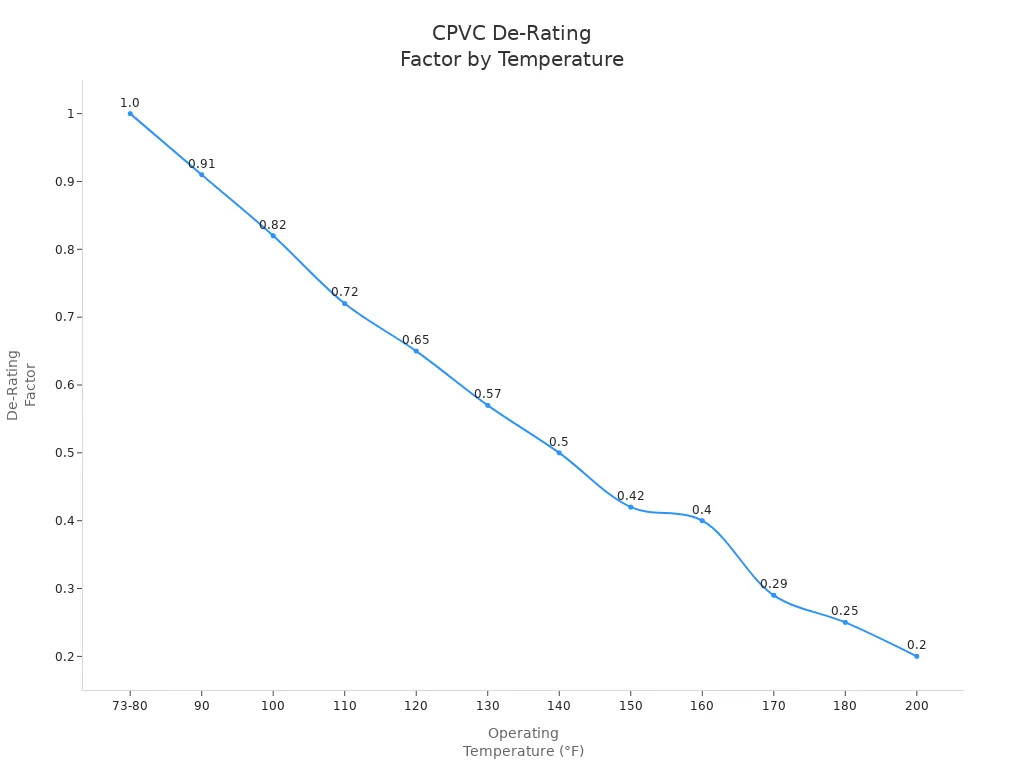
At 180°F, CPVC fittings can handle pressures significantly lower than at room temperature. For instance, a 1-inch Schedule 40 CPVC fitting can withstand 90 psi at 180°F, compared to 330 psi at 73°F.
PPR Pipe Fittings
PPR pipe fittings utilize the PN (Nominal Pressure) rating system, which indicates the maximum allowable continuous operating pressure at a reference temperature of 20°C (68°F). Key points regarding PPR pressure handling include:
- PPR fittings are rated as PN 10, PN 16, PN 20, and PN 25.
- The pressure capacity decreases with increased fluid temperature due to reduced mechanical strength.
- A PN 20 fitting may only perform at PN 10 levels at elevated temperatures.
Manufacturers provide derating tables to indicate reduced maximum working pressures at higher temperatures. It is essential to consult these tables for safe operation.
Installation Methods
Proper installation methods significantly impact the performance and longevity of CPVC and PPR pipe fittings in high-temperature applications. Each material requires specific techniques to ensure optimal functionality.
CPVC Pipe Fittings
When installing CPVC fittings, installers must consider several challenges that can affect long-term performance. The following table outlines key challenges and their descriptions:
| Challenge | Description |
|---|---|
| Exposure to UV light | CPVC pipes are vulnerable to UV damage if not protected, leading to potential degradation. |
| Extreme temperature changes | Rapid fluctuations can weaken the material, causing it to crack under high temperatures. |
| Improper storage | Storing in extreme conditions can make CPVC brittle, increasing the risk of breakage during use. |
PPR Pipe Fittings
For PPR fittings, installers should follow specific guidelines to ensure effective installation in high-temperature environments. Recommended practices include:
- Use proper pipe supports at recommended intervals to prevent sagging.
- Allow for thermal expansion with expansion loops or flexible sections.
- Follow manufacturer guidelines for fusion time, temperature, and insertion depth.
- Never use PPR fittings beyond their rated temperature or pressure limits.
By adhering to these installation methods, professionals can enhance the reliability and durability of both CPVC and PPR fittings in high-temperature applications. Proper installation not only ensures safety but also maximizes the lifespan of the plumbing systems.
Durability
Durability is a critical factor when selecting pipe fittings for high-temperature applications. Both CPVC and PPR fittings exhibit different lifespans and resistance to degradation under heat.
CPVC Pipe Fittings
CPVC pipe fittings, particularly those made from Lubrizol materials, are designed for a service life of 50 years in hot and cold water applications. They can withstand continuous temperatures up to 200°F (93°C) without losing structural integrity. This durability makes CPVC ideal for hot water systems. Key points regarding CPVC durability include:
- Maintains shape and performance under extreme temperature fluctuations.
- Resists warping or cracking, ensuring long-term functionality.
- Specifically designed to endure elevated temperatures, suitable for industrial processes.
PPR Pipe Fittings
In contrast, PPR pipe fittings have a shorter lifespan. They typically last 20–25 years in hot water systems, especially under high temperatures. Continuous exposure to temperatures above 70°C (158°F) accelerates aging. The following table summarizes the lifespan estimates for PPR fittings:
| Application | Lifespan Estimate |
|---|---|
| Hot Water Systems | 20–25 years under high temperatures; continuous exposure accelerates aging. |
PPR fittings can tolerate peak temperatures up to 95°C (203°F) for short durations. However, prolonged exposure to high temperatures can lead to deformation and weakening. Common causes of failure for PPR fittings include:
- Exposure to extreme heat exceeding 95°C.
- Thermal stress leading to deformation.
Understanding the durability of both CPVC and PPR fittings helps engineers and installers make informed decisions for high-temperature applications. Selecting the right material ensures safety and longevity in plumbing systems.
Chemical Resistance
Chemical resistance is a vital consideration when selecting pipe fittings for high-temperature applications. CPVC and PPR pipe fittings exhibit distinct chemical resistance profiles, impacting their suitability for various environments.
CPVC pipe fittings are engineered to withstand high temperatures while resisting chemical damage. They maintain structural integrity when exposed to various minerals, salts, and chemicals commonly found in hot water systems. Unlike metal pipes, which can corrode under heat, CPVC fittings excel in environments where chemical exposure is likely.
In contrast, PPR pipe fittings demonstrate impressive resistance to a variety of acids and bases. They can handle:
- Hydrochloric acid
- Sulfuric acid
- Acetic acid
PPR fittings maintain their integrity when transporting acidic solutions over extended periods. They also show high resistance to common bases like sodium hydroxide and potassium hydroxide. This makes them suitable for applications in wastewater treatment, where exposure to alkaline effluents occurs without significant degradation.
A comparative analysis of chemical resistance reveals the following:
| Pipe Type | Chemical Resistance | Continuous Operation Temperature | Peak Tolerance |
|---|---|---|---|
| CPVC | Strong resistance to chlorine and disinfectants, effective in high-temperature conditions | 60°C | 82°C |
| PPR | Resistant to dilute and moderately concentrated acids and common bases | 70°C | 95°C |
While CPVC offers strong resistance to chlorine, PPR’s resistance is moderate. Prolonged exposure to chlorine can degrade PPR pipes, leading to a loss of tensile strength. This highlights the importance of selecting CPVC for systems where chemical exposure is likely, ensuring safety and longevity in high-temperature applications.
In summary, CPVC pipe fittings outperform PPR in high-temperature applications. Key differences include:
- Temperature Resistance: CPVC withstands temperatures up to 100°C, while PPR is limited to 95°C.
- Pressure Handling: CPVC excels in industrial settings, whereas PPR suits residential plumbing.
- Installation: CPVC requires careful handling to avoid cracking, while PPR offers more flexibility during installation.
For applications involving hot water systems, CPVC is the recommended choice due to its superior performance. PPR remains a viable option for cold water systems and less demanding environments.
FAQ
What is the maximum temperature CPVC can handle?
CPVC can withstand temperatures up to 200°F (93°C) continuously.
How long do CPVC and PPR fittings last?
CPVC fittings last about 50 years, while PPR fittings typically last 20-25 years in high-temperature applications.
Can PPR fittings be used for hot water systems?
PPR fittings can handle short-term peaks of 95°C but are not ideal for continuous high-temperature applications.


