
Essential Criteria for Selecting Pipe Fittings in High-Pressure Systems
High-pressure fluid handling systems demand precise component selection to prevent catastrophic failure, leakage, and mechanical fatigue. In industrial piping environments, a pressure rating exceeding 150 PSI (1.03 MPa) is generally classified as high-pressure, requiring specialized fittings that maintain structural integrity under stress. The selection process must account for the Maximum Allowable Working Pressure (MAWP), chemical compatibility, and thermal expansion coefficients. Utilizing high-performance industrial ball valves alongside reinforced fittings ensures system reliability. According to the American Society of Mechanical Engineers (ASME B31.3), process piping must adhere to specific wall thickness and material strength ratios to mitigate the risk of burst cycles in volatile environments.
Material Properties and Burst Pressure Standards
The mechanical strength of a fitting is primarily dictated by its molecular density and wall thickness. In high-pressure applications, materials such as CPVC (Chlorinated Polyvinyl Chloride) and PPR (Polypropylene Random Copolymer) are preferred for their superior tensile strength compared to standard PVC. Technical data from the Plastics Pipe Institute (PPI) indicates that CPVC maintains significant structural rigidity at temperatures up to 200°F (93°C), making it a viable alternative to metallic fittings in corrosive chemical processing. Selecting high-durability CPVC pipe fittings involves verifying the Schedule 80 rating, which provides a thicker wall section designed to handle higher internal hydro-static pressure loads than Schedule 40 equivalents.
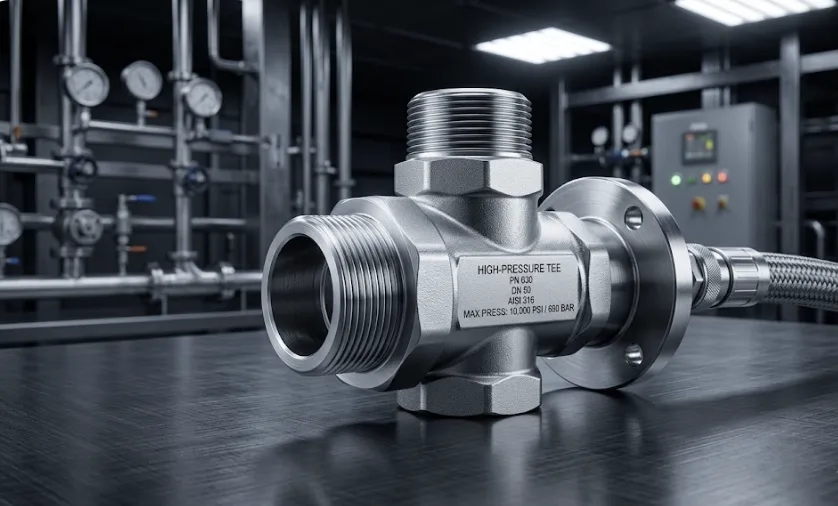
Material Strength Comparison Table (at 73°F / 23°C)
| Pipe Material | Standard | Pressure Rating | Application |
|---|---|---|---|
| Schedule 80 CPVC | ASTM F439 | 7,000 – 8,000 | Chemical Processing |
| PPR (PN20) | ISO 15874 | 3,000 – 4,000 | Hot Water Distribution |
| HDPE (PE100) | ISO 4427 | 3,500 – 4,500 | Industrial Mining |
| Schedule 80 PVC | ASTM D2467 | 6,000 – 7,000 | Water Treatment |
Technical Specifications of High-Pressure Valve Integration
Integrating flow control mechanisms requires fittings that can withstand the torque and vibration generated by rapid valve actuation. High-pressure systems often utilize 2/2-way solenoid valves to manage fluid spikes; however, the surrounding fittings must be rated to handle the resulting “water hammer” effect. Water hammer can generate pressure surges up to five times the steady-state operating pressure. Engineering reports from the Hydraulic Institute (HI) suggest that installing pulse-dampening fittings or heavy-duty flanges can reduce mechanical fatigue. Ensuring that the pvc octagonal ball valve interface matches the fitting’s pressure class is critical for preventing localized stress fractures at connection points.
Impact of Temperature on Pressure Ratings
Temperature is a critical inverse variable in thermoplastic fitting performance: as fluid temperature increases, the maximum pressure rating of the fitting decreases. This relationship is defined by a derating factor, a coefficient applied to the base pressure rating at 73°F. For instance, at 140°F (60°C), a standard PVC fitting may lose approximately 50% of its rated pressure capacity. Reference data provided by the National Institute of Standards and Technology (NIST) highlights that thermal expansion in high-pressure lines can lead to joint separation if expansion loops and appropriate PPR pipe fittings are not correctly implemented. Proper calculation of the derated pressure is mandatory for systems operating in fluctuating thermal environments.
Temperature Derating Factors for Thermoplastic Fittings
| Temperature | Item 1 | Item 2 | Item 3 |
|---|---|---|---|
| 73°F (23°C) | 1.00 | 1.00 | 1.00 |
| 110°F (43°C) | 0.50 | 0.82 | 0.85 |
| 140°F (60°C) | 0.22 | 0.65 | 0.70 |
| 180°F (82°C) | NR | 0.25 | 0.45 |
Joint Integrity and Connection Methodologies
The method used to join fittings significantly influences the overall pressure threshold of a piping network. In high-pressure thermoplastic systems, solvent welding creates a chemical bond that is often stronger than the pipe material itself. For materials like HDPE, butt fusion or electrofusion is the industry standard, creating a leak-proof monolithic structure. The Occupational Safety and Health Administration (OSHA) emphasizes that improper joint preparation is the leading cause of industrial piping failures. Utilizing precision-engineered HDPE pipe fittings ensures that the fusion zone remains uniform, preventing weak spots that could fail under 2026 updated safety pressure tests.
Chemical Resistance and Corrosion Management
Corrosion is a primary contributor to wall thinning and eventual rupture in high-pressure metal piping. Thermoplastic fittings offer a distinct advantage by being naturally resistant to electrochemical corrosion and a wide range of industrial acids. However, chemical compatibility must still be verified using the ASTM D1784 standard for rigid PVC and CPVC compounds. Exposure to incompatible surfactants or hydrocarbons can lead to Environmental Stress Cracking (ESC). In systems transporting aggressive media, selecting specialized industrial butterfly valves with chemically inert seals is necessary to maintain long-term pressure containment without degradation of the internal fitting surfaces.
Engineering Guidelines for System Installation
-
Verify Pressure Class: Always cross-reference the fitting’s SDR or Schedule with the maximum system surge pressure.
-
Account for Water Hammer: Install air chambers or surge tanks if using fast-closing valves in high-velocity lines.
-
Support and Alignment: Ensure all high-pressure fittings are supported by hangers that allow for thermal movement without creating localized bending moments.
-
Leak Testing Protocols: Conduct a hydro-static pressure test at 1.5 times the design pressure for a minimum of two hours before commissioning.
-
Component Compatibility: Avoid mixing different manufacturers’ fittings in high-pressure sections to ensure consistent tolerances and chemical bonding.
FAQ
How is the pressure rating of a fitting determined?
The rating is established through Long-Term Hydrostatic Strength (LTHS) testing, where fittings are subjected to sustained internal pressure over 10,000 hours. This data is extrapolated to determine the Hydrostatic Design Basis (HDB), ensuring the component can safely operate for its 50-year design life under specified conditions.
What is the difference between Schedule 40 and Schedule 80 fittings?
Schedule 80 fittings have a significantly thicker wall than Schedule 40, allowing them to handle higher internal pressures. While the outside diameter remains the same to accommodate standard sizing, the smaller internal diameter of Schedule 80 components provides the mechanical reinforcement needed for industrial high-pressure applications.
Can thermoplastic fittings be used for high-pressure compressed air?
Generally, standard PVC is not recommended for compressed air systems because it can fail in a brittle manner, creating dangerous shrapnel. However, specific high-impact modified materials or specialized piping systems designed for gas transport may be used if they comply with rigorous safety standards like ISO 4437.
Why do fittings fail at high pressures even when within their rating?
Premature failure is often caused by Cyclic Fatigue or Point Loading. If a system experiences frequent pressure fluctuations (pulsation) or if the fittings are stressed by poor alignment, the material may develop micro-cracks that lead to rupture far below the theoretical burst pressure.
What role does flow velocity play in fitting selection?
High flow velocities increase the kinetic energy of the fluid. If the velocity exceeds 5 feet per second (1.5 m/s), the risk of surge pressure (water hammer) increases during valve closure. Fittings must be selected not just for static pressure, but for the dynamic energy present in the moving fluid.


