
Introduction
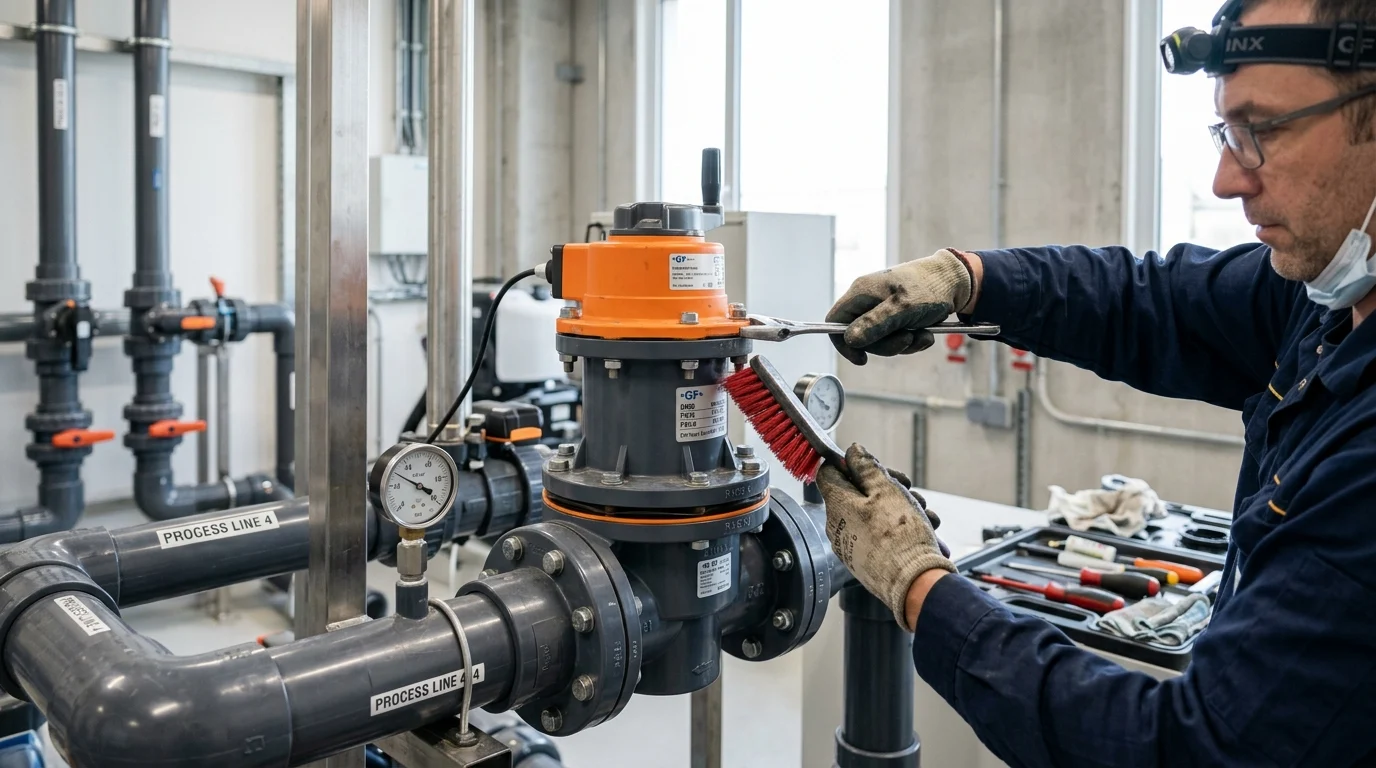
Outdoor plastic valves can handle aggressive media well, but sun, heat swings, moisture, dirt, and mechanical stress often shorten their life long before the process fluid does. A practical maintenance approach helps prevent surface degradation, seal failure, sticking operation, and unexpected leaks in above-ground installations. This article explains what typically damages thermoplastic valves outdoors, which inspection points matter most, and how cleaning, protection, lubrication choices, and replacement timing affect reliability. By the end, you’ll have a clear framework for extending service life, reducing unplanned downtime, and keeping valve performance stable in demanding outdoor conditions.
Why Outdoor Plastic Valve Maintenance Matters
Effective plastic valve maintenance is a critical component of asset management for industrial facilities operating in harsh outdoor environments. While thermoplastic valves offer exceptional resistance to internal chemical corrosion, their external surfaces remain highly vulnerable to atmospheric degradation when installed above ground. Without a structured maintenance protocol, the structural integrity and operational reliability of these fluid control assets can diminish rapidly, leading to fugitive emissions, process disruptions, and hazardous environmental leaks.
Industrial operators must recognize that outdoor installations present a unique set of compounding variables not found in climate-controlled indoor facilities. By understanding the specific environmental stressors acting upon the piping infrastructure, reliability engineers can implement targeted maintenance strategies that preserve the mechanical properties of the polymers and ensure long-term, leak-free operation.
Service life and uptime benefits
Implementing a rigorous maintenance schedule can extend the operational service life of thermoplastic valves from a baseline of 3 to 5 years to an optimized 10 to 15 years. Routine servicing directly correlates with maximized process uptime, a critical metric for continuous manufacturing operations where unplanned downtime can result in financial losses exceeding tens of thousands of dollars per hour.
Furthermore, well-maintained valves preserve their original flow coefficients (Cv) and actuation efficiencies. When moving parts are kept free of environmental debris and seals are periodically inspected, the energy required for pneumatic or electric actuation remains consistent, preventing premature wear on automated control systems.
Outdoor conditions that accelerate degradation
Thermoplastics exhibit significant sensitivity to environmental variables, primarily ultraviolet (UV) radiation and severe temperature fluctuations. UV exposure induces photo-oxidation, a chemical process that breaks the polymer chains, resulting in surface embrittlement and a reduction in impact strength.
Temperature extremes further accelerate degradation through thermal expansion and contraction. For example, standard Polyvinyl Chloride (PVC) possesses a coefficient of linear expansion of approximately 3.0 x 10^-5 in/in/°F. In outdoor environments experiencing a diurnal temperature swing of 40°F, a long pipe run can expand and contract significantly, placing immense shear stress on valve unions and flanged connections if not properly supported and maintained.
Common Failure Modes in Outdoor Plastic Valves
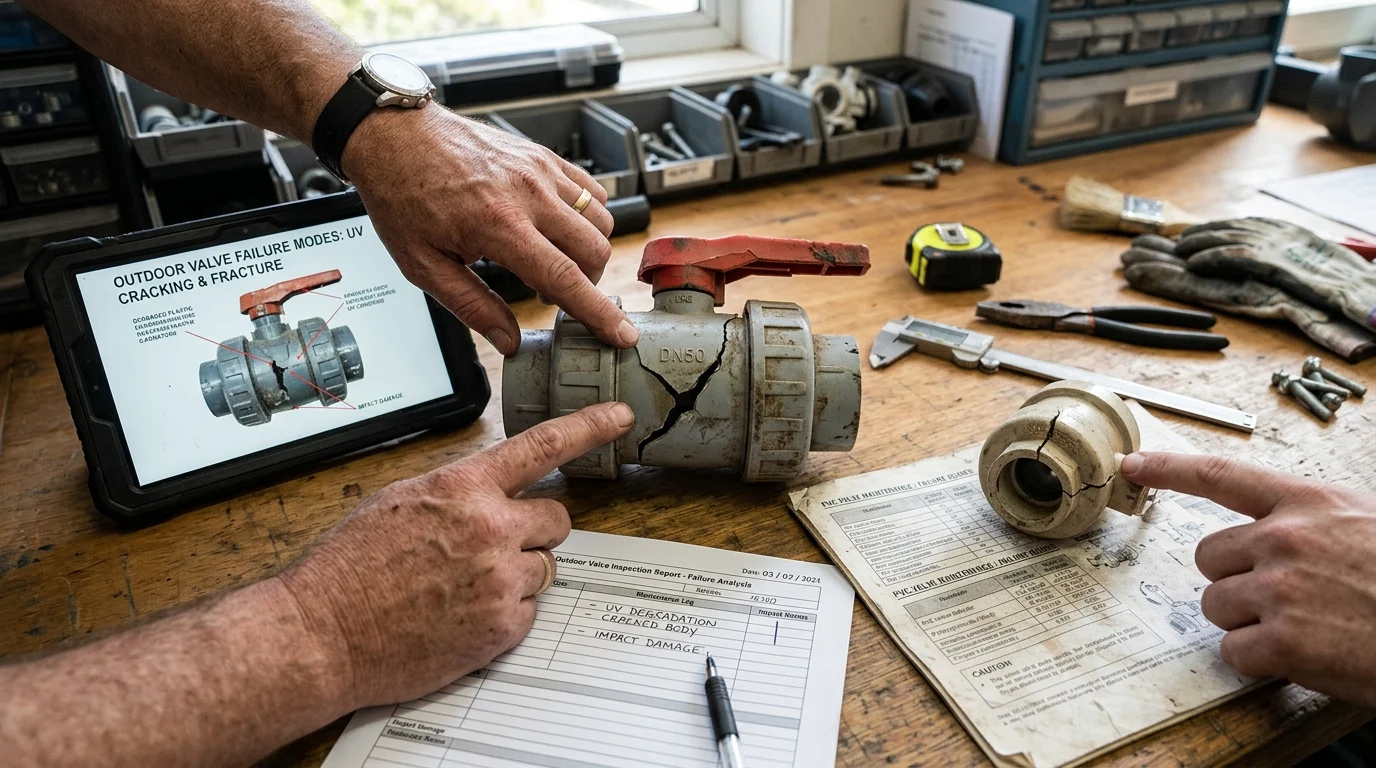
Understanding the mechanisms that precipitate valve failure enables reliability engineers to implement targeted preventative measures. Outdoor environments exploit both the chemical limitations of the selected thermoplastics and the mechanical vulnerabilities of the valve design.
Material and design factors
Material selection inherently dictates failure susceptibility. The degradation of elastomeric seals (such as EPDM or FKM O-rings) is a primary failure point. When exposed to ozone and extreme ambient heat, these elastomers lose their memory and elasticity, leading to compression set and subsequent fluid bypass.
Design factors also play a role. Valves with exposed threaded stems are prone to accumulating atmospheric particulate matter. This contamination increases operational friction. If actuation torque increases by 20% to 30% above a factory baseline of 150 in-lbs, it is a strong quantitative indicator of impending stem failure or seal rupture.
Typical outdoor damage mechanisms
Direct exposure to solar radiation initiates micro-cracking on the exterior of unprotected plastics. This UV embrittlement is often visually evident as surface chalking or severe discoloration within 12 to 24 months of unprotected direct sunlight exposure.
Additionally, Environmental Stress Cracking (ESC) occurs when the valve is subjected to simultaneous mechanical stress (such as overtightened union nuts or unsupported pipe weight) and chemical exposure (even from seemingly benign substances like certain atmospheric pollutants or incompatible cleaning agents). ESC accelerates the propagation of micro-cracks into full-thickness fractures.
How to assess failure risk
Risk assessment requires quantifying physical symptoms against baseline performance metrics to determine the remaining useful life of the asset. Hydrostatic pressure testing during scheduled turnarounds—typically performed at 1.5 times the maximum expected working pressure—can reveal micro-leaks before they escalate into catastrophic failures.
| Failure Mechanism | Early Indicator | Typical Time-to-Failure (Unmitigated) |
|---|---|---|
| UV Embrittlement | Surface chalking/discoloration | 12–24 months |
| Elastomer Degradation | Micro-leaks during pressure tests | 3–6 months |
| Thermal Fatigue | Actuation torque increase >20% | 6–12 months |
| Particulate Ingress | Stem binding/seizing | 1–4 weeks |
By utilizing this matrix, maintenance teams can assign risk scores to specific valves based on their visual condition and operational resistance, thereby prioritizing intervention before a system breach occurs.
Best Practices for Outdoor Plastic Valve Maintenance
Executing best practices for outdoor plastic valve maintenance requires transitioning from reactive troubleshooting to scheduled, preventative care. A comprehensive program encompasses physical inspections, environmental mitigation, and robust inventory management.
Inspection and cleaning routines
Facilities should mandate visual and tactile inspections at regular intervals, typically every 90 days for exposed systems. Inspectors must check for signs of weeping at union threads, discoloration of the valve body, and the presence of dirt or biological growth around moving parts.
Cleaning routines must be strictly controlled to prevent accidental chemical attack. Exterior surfaces should only be cleaned with mild, non-abrasive detergents (maintaining a pH of 6 to 8) and soft brushes. Solvents, petroleum-based lubricants, or harsh alkaline cleaners must be strictly prohibited, as they can rapidly dissolve or compromise PVC, CPVC, and PP substrates.
UV and weather protection methods
Mitigating UV and weather damage is the most effective method for preserving structural integrity. The application of weather-resistant lagging, localized enclosures, or specialized UV-resistant coatings can drastically alter the lifespan of the valve.
Installing a simple, ventilated aluminum or opaque fiberglass UV shield over a valve station can reduce the surface temperature of the plastic by up to 15°C (27°F) during peak summer months while blocking 99% of harmful UV radiation. For automated valves, these shields also protect sensitive electronic actuators and pneumatic positioners from rain and dust ingress.
Documentation and spare parts control
An optimized maintenance program relies heavily on meticulous documentation and inventory management. Every valve should be tagged with a unique asset identifier, and its maintenance history—including torque readings, seal replacements, and visual condition scores—must be logged in a centralized Computerized Maintenance Management System (CMMS).
Spare parts control is equally vital. Critical elastomeric components like diaphragms, seats, and O-rings have finite shelf lives. They must be stored in climate-controlled environments, ideally between 15°C and 25°C, away from direct sunlight and ozone-generating electrical equipment, to ensure they are viable when needed for a field rebuild.
Specification and Sourcing for Maintainable Valves
Proactive plastic valve maintenance begins during the procurement phase. Selecting the appropriate valve architecture and material formulation significantly dictates the required frequency and complexity of future maintenance tasks.
Selecting valves for outdoor maintainability
Engineers must prioritize architectures that facilitate inline serviceability. True union ball and diaphragm valves are industry standards for this reason; they allow maintenance technicians to unthread the union nuts and remove the valve body from the piping system without cutting the pipe or dismantling adjacent infrastructure.
Material selection must account for inherent UV stability. While standard PVC is cost-effective, it lacks native UV resistance. Specifying pigmented Polypropylene (PP) or Polyvinylidene Fluoride (PVDF) for highly exposed exterior applications can eliminate the need for secondary UV shielding, thereby reducing long-term maintenance overhead.
Standards and supplier quality checks
Rigorous vetting of supplier specifications prevents premature outdoor failure. Procurement teams should require suppliers to provide documentation on UV stabilizers, such as a minimum inclusion of 2% carbon black or titanium dioxide in the polymer matrix, which significantly enhances weathering resistance.
| Valve Material | UV Resistance (Uncoated) | Maximum Operating Temp | Relative Cost Factor |
|---|---|---|---|
| PVC | Low (Requires shielding) | 60°C (140°F) | 1.0x |
| CPVC | Low to Moderate | 93°C (200°F) | 1.5x |
| PP (Pigmented) | Moderate | 82°C (180°F) | 1.3x |
| PVDF | Excellent (Inherent) | 120°C (248°F) | 4.0x |
Furthermore, industrial buyers should mandate compliance with international standards such as ASTM F1970 or ISO 16136, and require a minimum 12-month operational warranty to safeguard against manufacturing defects that could exacerbate outdoor degradation.
Building a Practical Maintenance Strategy
A comprehensive strategy for plastic valve maintenance must balance technical requirements with economic realities. Facilities must establish clear decision-making frameworks to determine when maintenance is no longer viable and how to allocate labor effectively across vast piping networks.
Repair, retrofit, or replacement decisions
Maintenance managers frequently face the decision of whether to repair a degraded valve (e.g., replacing seals and seats) or replace it entirely. A standard industry benchmark is the 50% rule: if the total cost of repair—including labor, spare parts, and associated downtime—exceeds 50% of the cost of a new valve assembly, full replacement is the economically superior choice.
Labor time is a critical factor in this calculation. The average replacement time for a 2-inch true union plastic ball valve is under 30 minutes. Conversely, extracting the valve, disassembling it, cleaning the components, installing a rebuild kit, and bench-testing the unit can take between 90 to 120 minutes. In environments with high labor rates, full replacement often yields a better return on investment for smaller diameter valves.
Prioritizing assets by criticality
Asset prioritization ensures that limited maintenance resources are allocated effectively. Not all outdoor valves require the same level of scrutiny. Facilities should categorize their valve fleets using a criticality matrix based on fluid media, operational impact, and environmental risk.
Tier 1 assets (critical path processes, hazardous chemical lines) should receive high-frequency monthly inspections and proactive seal replacements every 24 months. Tier 3 assets (redundant systems, non-hazardous utility water) can be placed on an annual inspection cycle and operated on a run-to-failure basis if the consequence of failure is negligible. Utilizing Mean Time Between Failures (MTBF) data helps continuously refine these tier assignments and optimize the overall maintenance strategy.
Key Takeaways
- The most important conclusions and rationale for plastic valve maintenance
- Specs, compliance, and risk checks worth validating before you commit
- Practical next steps and caveats readers can apply immediately
Frequently Asked Questions
How often should outdoor plastic valves be inspected?
Inspect monthly in harsh sun or dusty areas, and at least quarterly in milder conditions. Check for chalking, discoloration, leaks, and harder operation.
What is the first sign of UV damage on plastic valves?
Surface chalking, fading, or slight brittleness are common early signs. Add UV shielding or covers promptly to slow further degradation.
Can overtightening shorten a plastic valve’s outdoor life?
Yes. Overtightened unions and unsupported pipe loads can trigger stress cracking. Follow torque guidance and support nearby piping properly.
Which parts need the most attention during maintenance?
Focus on seals, stems, union connections, and exposed threads. Clean debris, check for micro-leaks, and replace worn O-rings before failure.
What plastic valve options are suitable for outdoor water systems from Pntek?
For irrigation and water supply projects, Pntek offers UPVC, CPVC, PPR, and HDPE valve solutions. Match material to pressure, temperature, and outdoor exposure.


