
Introduction
Choosing between PVC ball valves and butterfly valves affects more than simple shutoff in industrial water systems. Each design handles flow, pressure drop, space limits, actuation, and maintenance differently, so the right option depends on pipe size, operating frequency, water quality, and system criticality. A poor match can increase energy use, accelerate seal wear, or reduce control reliability over time. This article compares how PVC ball valves and butterfly valves perform in real industrial settings, where each fits best, and what engineers should weigh when balancing cost, durability, and hydraulic performance before specifying a valve for service.
Why PVC ball valves vs butterfly valves matter
Selecting the appropriate thermoplastic isolation and control mechanisms is a foundational engineering decision in industrial water systems. Polyvinyl chloride (PVC) valves dominate corrosive and high-purity applications due to their exceptional chemical resistance, light weight, and favorable cost profile compared to metallic alternatives. However, the choice between PVC ball valves and butterfly valves fundamentally dictates system hydrodynamics, spatial footprint, and lifecycle maintenance requirements.
Engineers must evaluate these two valve typologies not merely as interchangeable on/off switches, but as highly specialized fluid control instruments. Misapplication can lead to excessive pressure drops, premature seal wear, or catastrophic system failure under water hammer conditions. Understanding the precise operational boundaries of each design—ranging from small-bore 1/2-inch dosing lines to massive 12-inch cooling water headers—is critical for optimizing capital expenditure and long-term reliability.
Operating profile and system criticality
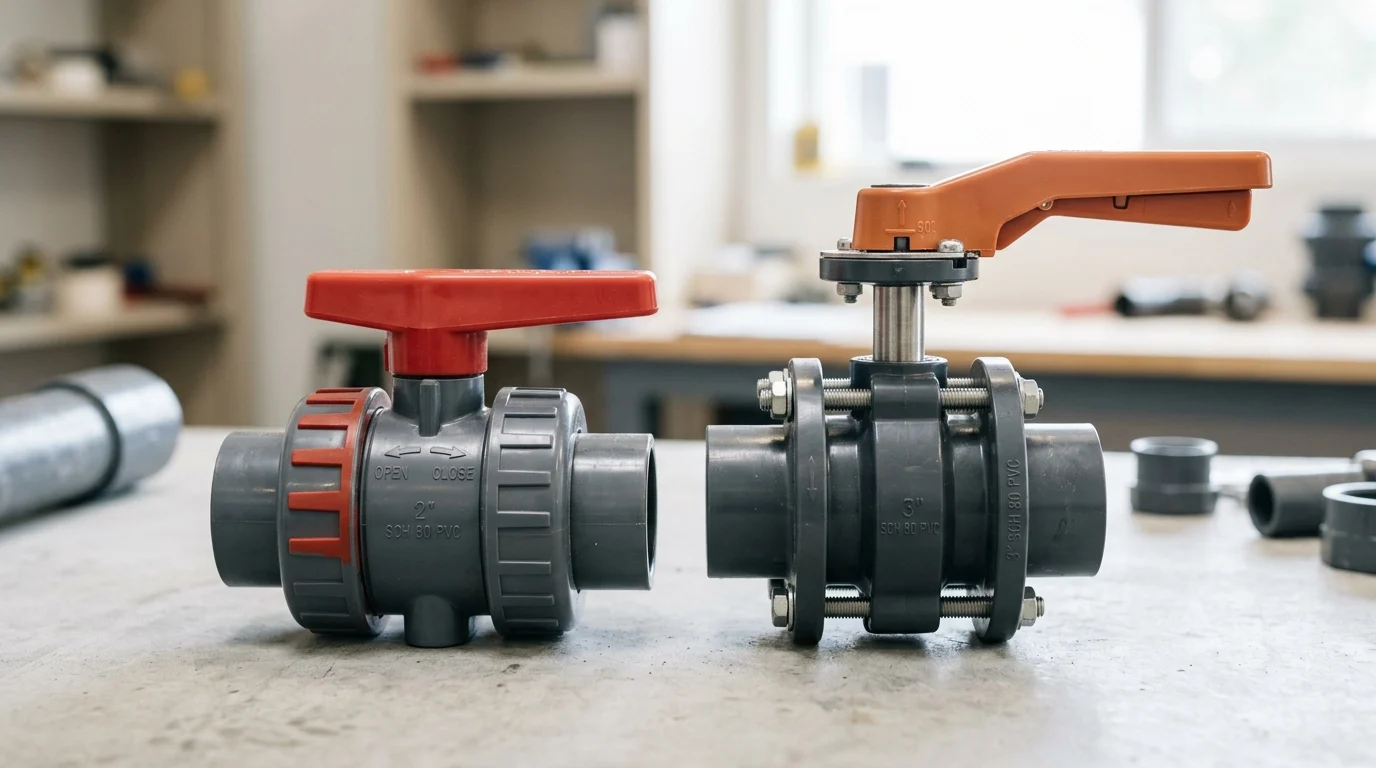
The operating profile of an industrial water system dictates the required flow coefficient (Cv), actuation frequency, and acceptable pressure drop. PVC ball valves feature a full-port design, meaning the internal bore matches the inner diameter of the pipeline. This configuration provides zero obstruction to flow when fully open, yielding exceptionally high Cv values. For example, a standard 4-inch PVC ball valve may boast a Cv exceeding 1,200 gallons per minute (GPM) at a 1 PSI pressure drop. Conversely, a butterfly valve introduces a disc into the flow path even when fully open, creating inherent turbulence and drag. A comparable 4-inch PVC butterfly valve typically yields a lower Cv of approximately 600 GPM. In critical systems where minimizing head loss and pump energy consumption is paramount, this hydrodynamic difference is highly consequential.
Typical use cases by application
Application environments heavily influence valve selection based on footprint and flow characteristics. PVC ball valves are the industry standard for chemical feed lines, aggressive wastewater dosing, and high-purity reverse osmosis (RO) skids, particularly in pipeline diameters under 3 inches. Their zero-dead-leg configurations and true union designs make them ideal for corrosive chemical handling. Butterfly valves, by contrast, dominate large-scale water distribution, cooling tower loops, and bulk effluent discharge lines. In these high-volume applications—often involving pipe diameters from 4 to 24 inches—the primary objectives are rapid isolation and space conservation. A butterfly valve's wafer or lugged body fits tightly between pipe flanges, requiring a fraction of the installation space demanded by a bulky large-diameter ball valve.
Core design and performance differences
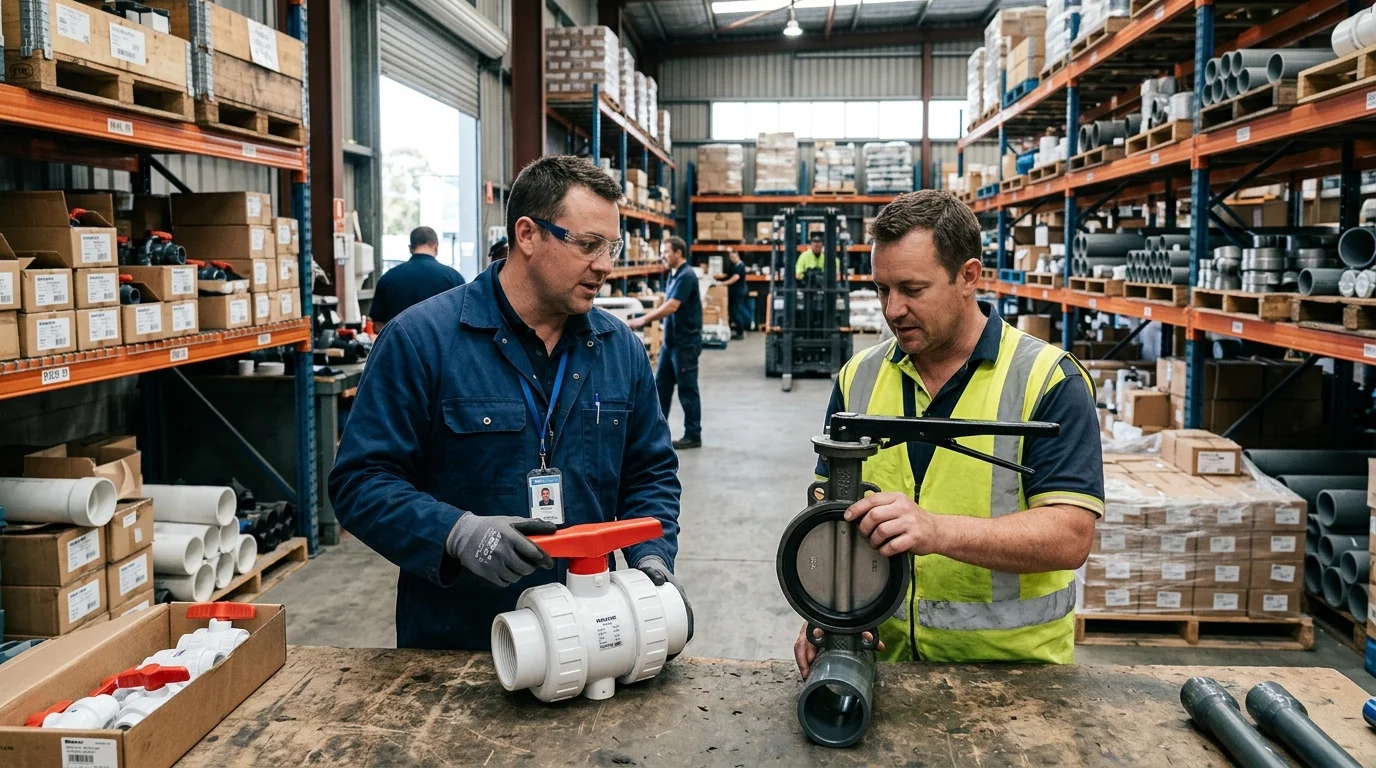
The fundamental mechanical differences between ball and butterfly configurations drive their respective performance envelopes. While both are quarter-turn rotary valves, their internal geometries dictate entirely different sealing mechanisms, torque requirements, and wear patterns over time.
Shutoff mechanism and flow characteristics
A PVC ball valve utilizes a spherical closure unit with a cylindrical through-hole. When actuated, the sphere rotates 90 degrees to either align with the flow path or block it completely against PTFE (Teflon) seats. This mechanism provides reliable, bubble-tight shutoff and is highly resistant to particulate damage if properly specified. A butterfly valve relies on a central shaft-mounted disc that rotates to seal against an elastomeric liner, typically EPDM or FKM (Viton). Because the disc remains suspended in the fluid stream, it is better suited for basic flow throttling than a standard ball valve, though it is more susceptible to fouling from fibrous debris.
| Feature | PVC Ball Valve | PVC Butterfly Valve |
|---|---|---|
| Closure Mechanism | Spherical ball with through-hole | Rotating disc on central shaft |
| Flow Path (Open) | Unobstructed (Full Port) | Obstructed (Disc in center) |
| Primary Seat Material | PTFE (Teflon) | Elastomeric (EPDM, FKM/Viton) |
| Throttling Capability | Poor (unless specialized V-port) | Moderate to Good |
Pressure rating torque and sealing performance
Pressure ratings and actuation torque diverge significantly between the two designs. High-quality PVC ball valves in smaller diameters (up to 2 inches) are routinely rated for maximum internal pressures of 232 PSI (16 bar) at 73°F (23°C). However, the friction generated by the ball turning against two full-circumference PTFE seats results in high breakaway torque, often exceeding 500 in-lbs for sizes larger than 3 inches. PVC butterfly valves, due to their lower-friction disc-to-liner engagement, require substantially less operating torque. However, their pressure containment capability is lower; most industrial PVC butterfly valves are capped at a maximum working pressure of 150 PSI (10 bar) at 73°F, with some larger diameters derated to 100 PSI or less.
How to compare cost and maintenance
Total cost of ownership (TCO) in industrial fluid control extends far beyond the initial purchase price of the valve. A comprehensive cost analysis must integrate installation labor, structural support requirements, lifecycle maintenance, and the secondary costs of automated actuation.
Installation and replacement costs
In pipe sizes under 2 inches, PVC ball valves are remarkably cost-effective and represent the default choice for most contractors. However, as pipeline diameters increase to 4 inches and beyond, the cost and weight of true union ball valves escalate exponentially. A 6-inch PVC ball valve is a massive, heavy component that demands specialized structural pipe supports to prevent sagging and stress fractures at the joints. In contrast, a 6-inch PVC butterfly valve offers a highly compact face-to-face dimension—often just 2.5 to 3 inches thick—and weighs up to 70% less than a comparable ball valve. This translates to dramatic reductions in component cost and installation labor for large-bore systems.
Maintenance frequency and automation needs
Maintenance protocols and automation requirements further differentiate the two options. True union PVC ball valves feature radial sealing O-rings and threaded union nuts, allowing technicians to unthread the valve body and remove it from the pipeline for seat replacement without cutting the pipe. Butterfly valves require the loosening and removal of heavy flange bolts to extract the valve body. When it comes to automation, the torque disparity plays a major role in capital costs. Because butterfly valves require lower breakaway torque, they can be paired with smaller, less expensive pneumatic or electric actuators. For instance, actuating a high-torque 4-inch ball valve may require a heavy-duty electric actuator with a 10- to 15-second cycle time, whereas a 4-inch butterfly valve can often utilize a lighter pneumatic rack-and-pinion actuator capable of 1- to 3-second cycle times.
How to choose the right valve
Selecting the optimal valve requires a systematic evaluation of hydraulic parameters, physical space limitations, and precise chemical compatibility. Relying on generalized rules of thumb can lead to over-specification, driving up costs, or under-specification, resulting in premature failure.
Step by step selection process
The specification process must begin with a rigorous assessment of the system's operating pressure and temperature. Because PVC is a thermoplastic, its structural integrity is highly temperature-dependent. All PVC valves are baseline-rated at 73°F (23°C). As fluid temperatures approach the material's maximum limit of 140°F (60°C), the pressure rating must be severely derated. An engineer must apply the manufacturer's derating curve; a valve rated for 150 PSI at 73°F may safely handle only 30 PSI at 130°F. Once the temperature-corrected pressure envelope is established, the designer must evaluate the required Cv, the spatial footprint available, and whether the primary function is strict isolation or flow modulation.
When ball valves are the better choice
Ball valves are the undisputed choice for small-bore, high-pressure, and high-purity applications. When the system operates between 150 PSI and 232 PSI, ball valves provide the necessary pressure containment that butterfly valves lack. They are also mandatory in systems where zero pressure drop is required to maintain pump efficiency, or where the fluid contains highly aggressive chemicals that could attack the metallic shaft of a butterfly valve (even if the shaft is technically isolated by the liner). Additionally, true union ball valves are vastly superior in spaces where inline maintenance and rapid swap-outs are prioritized over initial capital cost.
When butterfly valves are the better choice
Butterfly valves become the superior engineering choice as soon as pipeline diameters exceed 3 to 4 inches, provided the system pressure remains below 150 PSI. They are ideal for cooling water loops, municipal water treatment plants, and bulk fluid transfer where minimizing the physical footprint and reducing structural load on the piping system is critical. Furthermore, if an application requires frequent throttling to balance flow rates, a butterfly valve equipped with a notched positioning lever or a modulating actuator offers far better linear flow control than a standard ball valve.
| Selection Criteria | PVC Ball Valve Preference | PVC Butterfly Valve Preference |
|---|---|---|
| Optimal Pipe Size | 1/2 inch to 3 inches | 4 inches to 24+ inches |
| Maximum Pressure (at 73°F) | Up to 232 PSI | Up to 150 PSI |
| Space Constraints | Requires long face-to-face clearance | Highly compact (Wafer style) |
| Flow Resistance | Negligible (High Cv) | Noticeable drag (Moderate Cv) |
Decision framework and specification tips
Translating a valve selection into a formal procurement specification requires strict adherence to industry standards and an understanding of supply chain variables. Ambiguous specifications often lead to the installation of substandard commercial-grade valves in demanding industrial environments.
Procurement and specification guidance
When drafting procurement documents, engineers must specify the exact PVC compound grade, typically requiring compliance with ASTM D1784 for rigid poly(vinyl chloride) compounds. For butterfly valves, the specification must clearly state the required flange bolt pattern (e.g., ANSI B16.5 Class 150) and whether a wafer or lugged body is required for dead-end service. Seal material must be explicitly called out based on chemical compatibility; specifying EPDM for water is standard, but FKM may be necessary if trace hydrocarbons are present. From a supply chain perspective, buyers should anticipate lead times of 4 to 6 weeks for specialized automated valve packages. Furthermore, if custom O-ring materials (such as Kalrez) or non-standard actuation brackets are required, manufacturers frequently impose Minimum Order Quantities (MOQs) ranging from 50 to 100 units, which must be factored into project timelines and budgets.
Key Takeaways
- The most important conclusions and rationale for PVC ball valves vs butterfly valves
- Specs, compliance, and risk checks worth validating before you commit
- Practical next steps and caveats readers can apply immediately
Frequently Asked Questions
When should I choose a PVC ball valve over a butterfly valve?
Choose a PVC ball valve for tight shutoff, low pressure drop, and smaller lines, especially under 3 inches in chemical feed, RO, or dosing systems.
When is a PVC butterfly valve the better option?
Use a butterfly valve for larger water lines, typically 4 inches and above, where compact installation, lighter weight, and fast isolation matter most.
Which valve has lower pressure loss in industrial water systems?
A PVC ball valve usually has lower pressure loss because its full-port bore creates less flow restriction than a butterfly valve’s center disc.
Are PVC butterfly valves suitable for throttling flow?
Yes, for basic throttling. Butterfly valves handle modulating service better than standard ball valves, which are generally better for full open or full close duty.
Can Pntek help match the right plastic valve to my piping system?
Yes. Pntek supplies PVC and other plastic valves, pipes, and fittings, and can support fast quote requests for irrigation, construction, and water supply projects.


