
Introduction
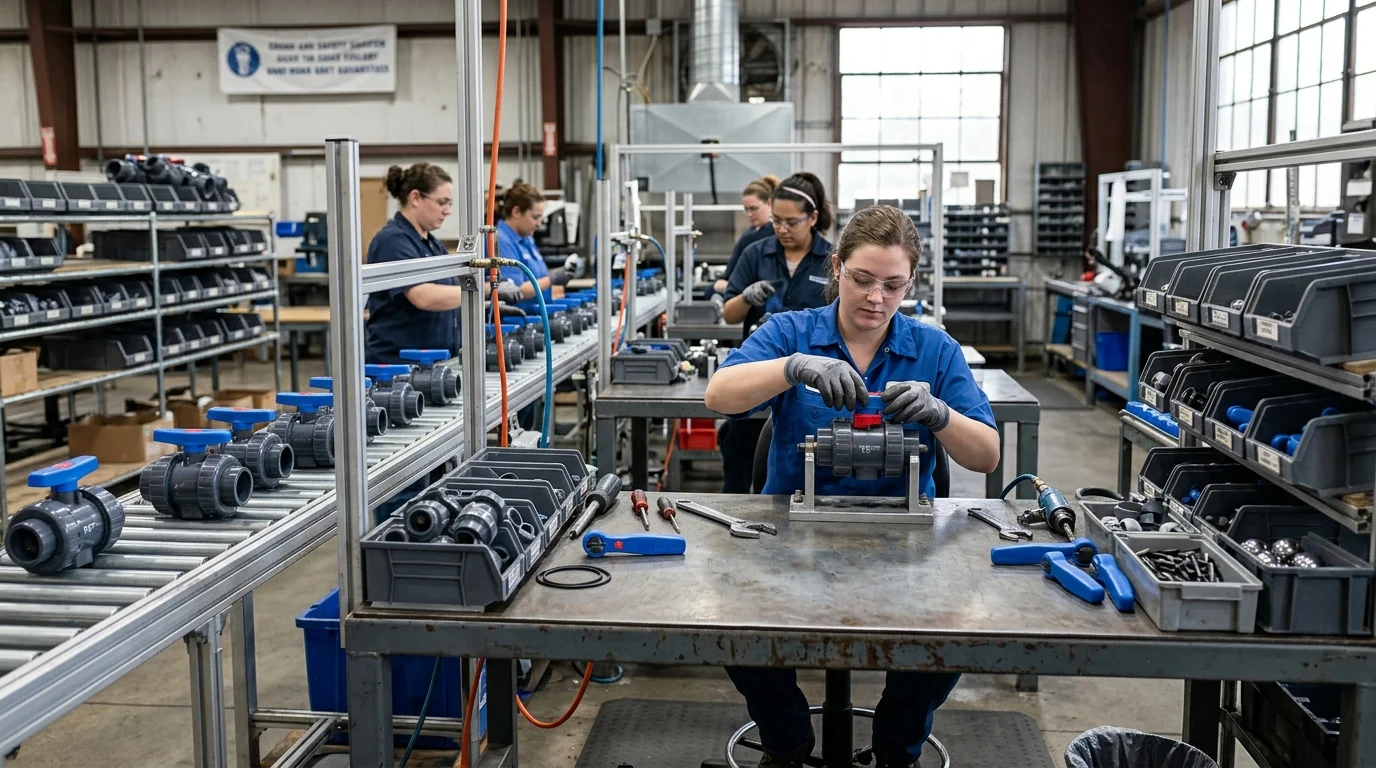
Selecting an OEM PVC ball valve factory affects far more than component cost in water filtration equipment. Valve quality influences pressure stability, leak prevention, service life, and the consistency of every assembled system, especially in applications that run continuously under demanding flow conditions. This article explains what a specialized OEM factory contributes to filtration performance, from material control and molding precision to tolerance management and long-term reliability. It also helps readers understand which manufacturing capabilities matter most when evaluating suppliers for commercial, industrial, or municipal water treatment projects.
Why OEM PVC Ball Valve Factories Matter
Partnering with a specialized OEM PVC ball valve factory is a critical strategic decision for manufacturers of commercial and industrial water filtration equipment. Valves are the primary control points within fluid management networks, and their reliability directly impacts the overall uptime of the filtration system. In high-stakes environments such as municipal water treatment or industrial reverse osmosis, component failure is not merely an inconvenience; it can lead to catastrophic system downtime, fluid contamination, and severe equipment damage.
Because filtration systems frequently operate under continuous hydraulic stress, sourcing from a dedicated OEM manufacturer ensures that the valves are engineered to withstand specific environmental demands. These factories possess the specialized tooling and resin formulations required to produce valves that maintain structural integrity under continuous operating pressures often reaching 150 to 232 PSI (10.3 to 16.0 bar) at standard ambient temperatures (73°F/23°C).
Impact on product consistency and performance
The primary advantage of utilizing an established OEM partner lies in strict dimensional and material consistency. High-tier factories maintain stringent machining and molding tolerances, often keeping dimensional variances below +/- 0.02 to 0.05 mm on critical internal components like valve stems and seating spheres. This precision is non-negotiable for preventing micro-leaks and ensuring smooth actuation over a projected lifespan of 10,000 to 25,000 mechanical cycles.
Furthermore, consistency in the unplasticized polyvinyl chloride (UPVC) resin blend dictates the valve’s resistance to chemical degradation and UV exposure. A reliable factory implements robust incoming material inspections to verify resin purity (typically demanding >99% virgin UPVC), ensuring that batch-to-batch variations do not compromise the burst pressure—which should exceed 3.0 to 4.0 times the rated working pressure—or the mechanical strength of the final product.
Key applications in water filtration equipment
Within the water filtration sector, PVC ball valves are ubiquitous across multiple stages of the treatment process. They serve as primary isolation valves on reverse osmosis (RO) skids, control backwash flows in multimedia filters, and regulate chemical dosing lines where corrosion resistance is paramount. The non-reactive nature of UPVC makes it highly suitable for handling aggressive cleaning agents like sodium hypochlorite (up to 12-15% concentration) or hydrochloric acid, which are frequently used in membrane clean-in-place (CIP) procedures.
Filtration equipment typically utilizes valve sizes ranging from 1/2-inch for sampling and dosing lines (handling ~5-10 GPM), up to 4-inch or 6-inch diameters for main header isolation (managing 500+ GPM). An OEM factory capable of producing this entire size spectrum allows equipment builders to consolidate their supply chain, ensuring uniform aesthetic and performance characteristics across all fluid control points on a complex skid.
Technical Specifications Buyers Should Evaluate
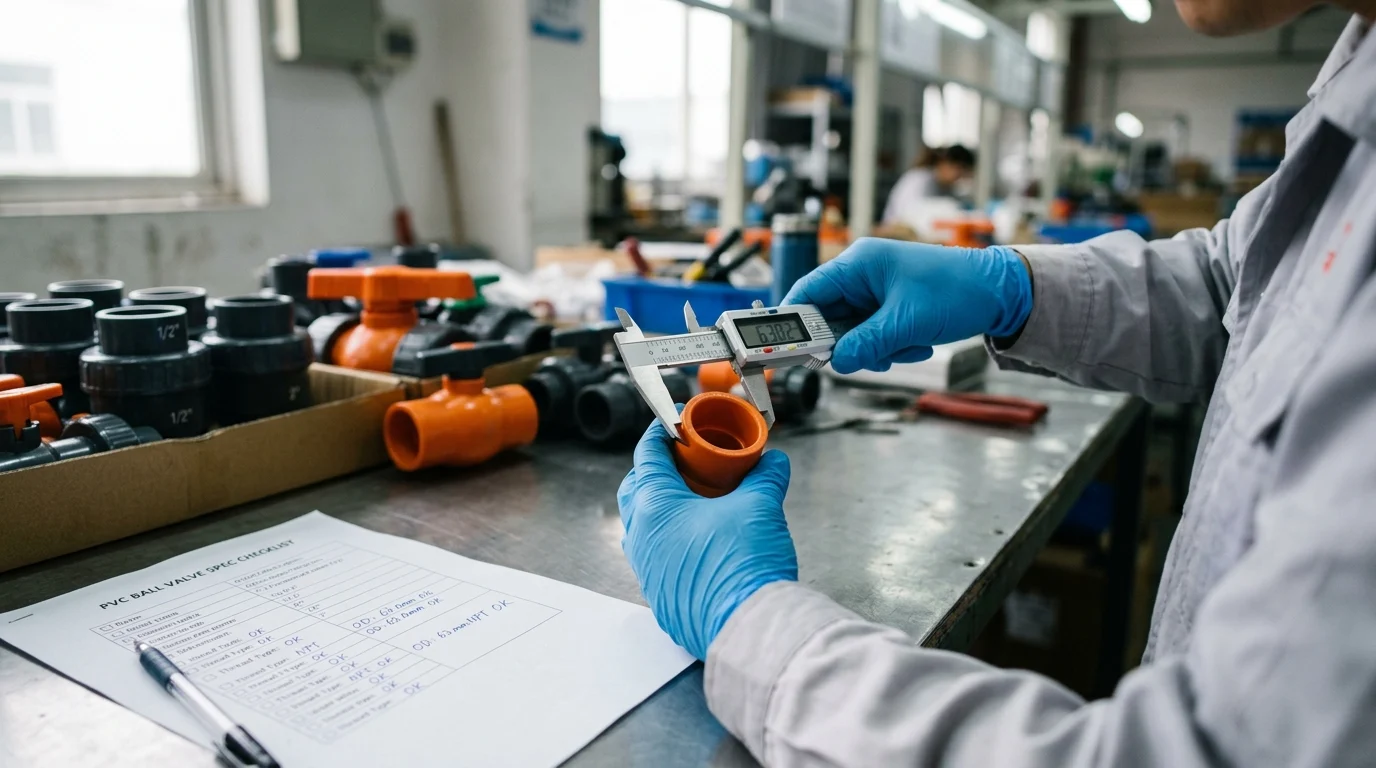
The technical viability of a PVC ball valve hinges on a comprehensive evaluation of its design specifications. Procurement engineers must align the valve’s physical parameters with the hydraulic and chemical realities of the target filtration equipment. Relying solely on external dimensions is insufficient; the internal architecture, material composition, and pressure ratings dictate the component’s true operational ceiling.
Material, sealing, pressure, and connection requirements
The foundation of any industrial PVC valve is the polymer itself, typically UPVC for standard water applications or CPVC where elevated temperatures (up to 200°F/93°C) are present. Sealing materials are equally critical. Standard EPDM O-rings are suitable for general water filtration, but applications involving ozone treatment or aggressive chemicals require FPM/FKM (fluoroelastomer) seals to prevent premature degradation. The valve seats must be machined from virgin PTFE (Teflon) to guarantee low-friction actuation and bubble-tight shutoff.
Pressure ratings must align with system dynamics. Reputable OEM PVC ball valve factory outputs are typically rated at PN10 (145 PSI) or PN16 (232 PSI) at 73°F (23°C). Engineers must also specify the correct end connections—such as solvent cement sockets (ANSI/DIN/JIS standards), NPT/BSPT female threads, or flanged ends—to ensure seamless integration into the skid’s piping architecture.
Full-port vs reduced-port design comparison
A critical design choice in fluid management is selecting between full-port and reduced-port (standard-port) valve configurations. Full-port valves feature an internal bore diameter equal to the inner diameter of the connecting pipe. This design eliminates flow restriction, maximizing the flow coefficient (Cv) and virtually eliminating pressure drops across the valve. This is highly beneficial in pump suction lines where avoiding cavitation is critical.
Conversely, reduced-port valves have a smaller internal bore, typically restricting flow cross-section by 15% to 20% (e.g., reducing the Cv value from roughly 120 to 90 on a standard 2-inch valve). While this introduces a measurable pressure drop and slight fluid turbulence, reduced-port valves require less raw material and smaller actuator torques. For discharge lines or bypass loops where slight pressure reductions are acceptable, reduced-port designs offer a highly cost-effective alternative without sacrificing pressure boundary integrity.
Useful comparison criteria for OEM PVC ball valves
When comparing technical specifications from different OEM factories, buyers should utilize a standardized matrix to evaluate performance metrics objectively. Key criteria include the flow coefficient, maximum operating pressure, and the torque required for actuation—which is especially important if the valves will be retrofitted with pneumatic or electric actuators.
| Specification Feature | Full-Port Design | Reduced-Port Design |
|---|---|---|
| Internal Bore Size | 100% of pipe ID | Approx. 80-85% of pipe ID |
| Flow Coefficient (Cv) | Maximum (e.g., ~120 for 2″) | Reduced by 15-30% (e.g., ~90 for 2″) |
| Pressure Drop (ΔP) | Minimal (< 1 PSI at standard flow) | Moderate (1-3 PSI depending on velocity) |
| Actuation Torque | Higher (Requires larger actuators) | Lower (Suitable for compact actuators) |
| Material Cost Index | 1.0x (Baseline) | 0.75x – 0.85x |
How to Assess Manufacturing Quality
Evaluating an OEM PVC ball valve factory requires looking beyond the product catalog to assess the underlying manufacturing infrastructure. The true quality of a valve is established on the factory floor through rigorous process controls, advanced machinery, and a deeply ingrained culture of quality assurance. For water filtration OEMs, deploying a defective valve can result in catastrophic site failures, making factory assessment a critical risk mitigation step.
Production controls, testing, and traceability
Top-tier factories utilize closed-loop injection molding machines ranging from 150-ton to 800-ton clamping forces, ensuring precise material distribution, maintaining dimensional stability within a 0.1% shrink rate, and eliminating void formation within the valve body. Post-molding, the assembly process must be tightly controlled. The most critical quality gate is the hydrostatic pressure test. Industry standards dictate that 100% of production units must undergo pneumatic or hydrostatic testing at 1.5 times their rated working pressure (e.g., testing a 150 PSI valve at 225 PSI) for a minimum of 60 to 120 seconds to verify seal integrity.
Traceability is another hallmark of advanced production controls. Each production batch should be marked with a molded-in or laser-etched date code. In the event of a field failure, this traceability allows the manufacturer to isolate the specific shift, resin batch, and molding machine involved, preventing widespread product recalls and facilitating rapid root-cause analysis.
Certifications and potable water compliance
For equipment destined for potable water applications, municipal drinking water plants, or food-grade filtration, factory certifications are non-negotiable. An elite OEM factory will hold, at minimum, ISO 9001:2015 certification for its quality management systems. More importantly, the specific valve lines must comply with NSF/ANSI 61 for drinking water system components, ensuring no harmful chemicals (with extractable limits often capped under 10 ppb for specific VOCs) leach into the water stream.
Additionally, compliance with NSF/ANSI 372 or equivalent international standards (such as WRAS in the UK or ACS in France) is required to verify the product meets strict low-lead requirements (containing less than 0.25% weighted average lead content). Buyers must request current, third-party validation certificates rather than relying solely on self-declared compliance.
Private label and custom production capabilities
A primary benefit of engaging an OEM PVC ball valve factory is the ability to leverage custom production capabilities. Filtration equipment manufacturers often require private labeling to protect their aftermarket replacement parts business. Factories can accommodate this through custom injection mold inserts, embedding the client’s logo directly into the valve handle or body.
Customization extends to color-coding for specific fluid lines (e.g., blue handles for raw water, red for wastewater, yellow for chemical dosing) using precise Pantone-matched masterbatch resins. When bespoke valve dimensions or unique end-connections are required, buyers should evaluate the factory’s in-house tooling capabilities. A well-equipped factory can design, cut, and commission a new injection mold within a 30 to 45-day lead time for initial T1 samples, significantly accelerating the time-to-market for proprietary filtration systems.
Commercial and Sourcing Risk Factors
While technical specifications and quality controls are paramount, the commercial realities of global sourcing introduce distinct risk factors that must be managed proactively. An OEM partnership is a long-term financial commitment, and buyers must navigate variables related to raw material economics, production minimums, and supply chain logistics to maintain profitable margins on their filtration equipment.
Raw materials, tooling, and order volume considerations
The cost structure of a PVC ball valve is heavily dependent on the global commodity pricing of PVC resin and petroleum derivatives. Buyers should negotiate transparent pricing models that index the unit cost to raw material benchmarks. Order volume significantly impacts pricing; typical Minimum Order Quantities (MOQs) for standard sizes range from 1,000 to 5,000 units per size, with standard production lead times of 25 to 40 days. Purchasing below these thresholds often incurs steep setup surcharges.
Tooling costs for custom designs represent another major capital outlay. A multi-cavity injection mold for a custom valve body can range from $3,000 to $10,000 depending on complexity and steel quality, with tooling life guarantees typically spanning 500,000 to 1,000,000 cycles for hardened H13 steel. Buyers should negotiate tooling amortization agreements, where the mold cost is rebated after a specific volume threshold—typically 100,000 to 200,000 molded shots—is achieved.
Common sourcing risks and claim prevention
A prevalent sourcing risk in polymer manufacturing is the unauthorized use of recycled resin (regrind). To cut costs, unscrupulous suppliers may blend high percentages of regrind with virgin resin, resulting in micro-cracking, reduced impact strength, and premature valve failure. Contracts must explicitly cap regrind usage at an industry-acceptable maximum of 5%, while premium lines should mandate 0% regrind, verifiable through material composition audits.
Another common failure point is handle torque failure, where brittle handles snap under the force required to turn a stiff valve. High-quality factories mitigate this by blending ABS or specific impact modifiers into the handle resin, ensuring it can withstand torque forces exceeding 15 to 25 N·m depending on the valve size. Establishing clear Acceptable Quality Limit (AQL) standards—such as AQL 1.5 for major defects and 4.0 for minor defects—provides a legal framework for claim prevention and batch rejection before shipment.
Supplier qualification process
Mitigating commercial risks requires a formalized supplier qualification process. Before awarding a contract, buyers must execute a comprehensive audit of the OEM PVC ball valve factory. This process should evaluate financial stability, historical production capacity, and workforce retention rates. A factory with high operator turnover is highly susceptible to assembly errors and inconsistent testing protocols.
The qualification process should culminate in a pilot production run. Ordering a limited sample batch of 100 to 500 units allows the buyer’s engineering team to perform destructive testing, verify dimensional tolerances against CAD models, and validate the factory’s packaging and export logistics before committing to high-volume blanket orders. The ultimate goal of this phase is to confirm target defect rates remain below 500 Parts Per Million (PPM).
Decision Framework for Supplier Selection
The ultimate decision to partner with a specific OEM PVC ball valve factory requires a balanced, data-driven framework. Sourcing professionals must synthesize technical validations, quality audits, and commercial negotiations into a cohesive strategy that minimizes total cost of ownership (TCO) while guaranteeing supply chain resilience.
Balancing technical fit, compliance, and total cost
Focusing exclusively on the lowest per-unit cost is a flawed strategy that frequently results in elevated TCO due to increased failure rates, warranty claims, and system downtime.
Key Takeaways
- The most important conclusions and rationale for OEM PVC ball valve factory
- Specs, compliance, and risk checks worth validating before you commit
- Practical next steps and caveats readers can apply immediately
Frequently Asked Questions
What pressure rating should an OEM PVC ball valve have for water filtration equipment?
For most systems, choose PN10 or PN16 valves, about 145 to 232 PSI at 73°F. Match the rating to your actual operating pressure and safety margin.
Which material is better for filtration valves, UPVC or CPVC?
Use UPVC for standard water applications and CPVC when higher temperatures are expected. CPVC is better for hotter process lines and more demanding thermal conditions.
What seal materials should I specify for OEM PVC ball valves?
EPDM works well for general water filtration. For ozone or aggressive chemical dosing and cleaning lines, specify FKM or FPM seals with PTFE seats.
Should I choose full-port or reduced-port PVC ball valves?
Choose full-port valves when you need maximum flow and low pressure drop, especially on main lines. Reduced-port valves can work on smaller control or secondary lines.
Can Pntek support OEM PVC ball valves with different connection standards?
Yes, Pntek can support common socket, threaded, and flanged options for integrated piping systems. Confirm your required ANSI, DIN, JIS, NPT, or BSPT standard before ordering.


