
Introduction
Industrial pipeline systems depend on more than pipe material alone; fitting quality often determines whether a network performs reliably under pressure, chemicals, and long service cycles. China has become a major source for these components, but manufacturers vary widely in production standards, engineering support, certifications, and customization capability. This article outlines what sets the best Chinese plastic pipe fitting manufacturers apart for industrial pipeline engineering, including material selection, dimensional precision, capacity, and quality control. Readers will gain a practical basis for comparing suppliers and identifying partners that can support demanding project requirements with consistent, specification-driven manufacturing.
Why Choosing the Right Plastic Pipe Fittings Supplier Matters
Industrial pipeline engineering relies heavily on the structural integrity, chemical compatibility, and dimensional accuracy of fluid conveyance systems. Within these systems, plastic pipe fittings serve as the critical nodes, dictating the overall reliability of the network. Unlike standard commercial plumbing, industrial applications—ranging from chemical processing and semiconductor manufacturing to municipal water treatment—subject pipelines to aggressive media, severe thermal cycling, and continuous hydraulic stress.
Sourcing these critical components requires identifying a plastic pipe fittings supplier capable of meeting rigorous engineering specifications. China has emerged as a dominant global hub for polymer manufacturing, housing facilities that integrate advanced resin compounding, precision injection molding, and comprehensive quality assurance. Selecting the right manufacturing partner mitigates the risk of catastrophic joint failures, which can result in costly downtime or severe environmental hazards.
How Leading China Manufacturers Support Industrial Buyers
Top-tier manufacturers in China have evolved from basic component producers into comprehensive supply chain partners for industrial buyers. These facilities leverage high-tonnage injection molding machines and automated demolding robotics to achieve strict production tolerances. For large-scale industrial projects, leading suppliers routinely manage production capacities exceeding 500,000 pieces per month, ensuring that high-volume orders are fulfilled without compromising dimensional stability.
Furthermore, elite manufacturers offer robust engineering support, including mold flow analysis and custom tooling design. This capability is essential for industrial buyers requiring specialized geometries or proprietary thread specifications that deviate from standard catalogs. By partnering with a technologically advanced factory, procurement teams gain access to rapid prototyping and scalable production, reducing the time-to-market for complex pipeline infrastructure.
Key Fitting Types and Resin Systems
The performance of a pipeline is intrinsically linked to the resin system utilized. Unplasticized Polyvinyl Chloride (UPVC) remains the industry standard for general chemical and water handling, operating reliably up to 60°C. However, more demanding environments necessitate advanced polymers. Chlorinated Polyvinyl Chloride (CPVC) extends thermal thresholds to 95°C, while Polypropylene Homopolymer (PPH) and Polyvinylidene Fluoride (PVDF) provide exceptional resistance to highly aggressive acids and halogens, with PVDF withstanding temperatures up to 140°C.
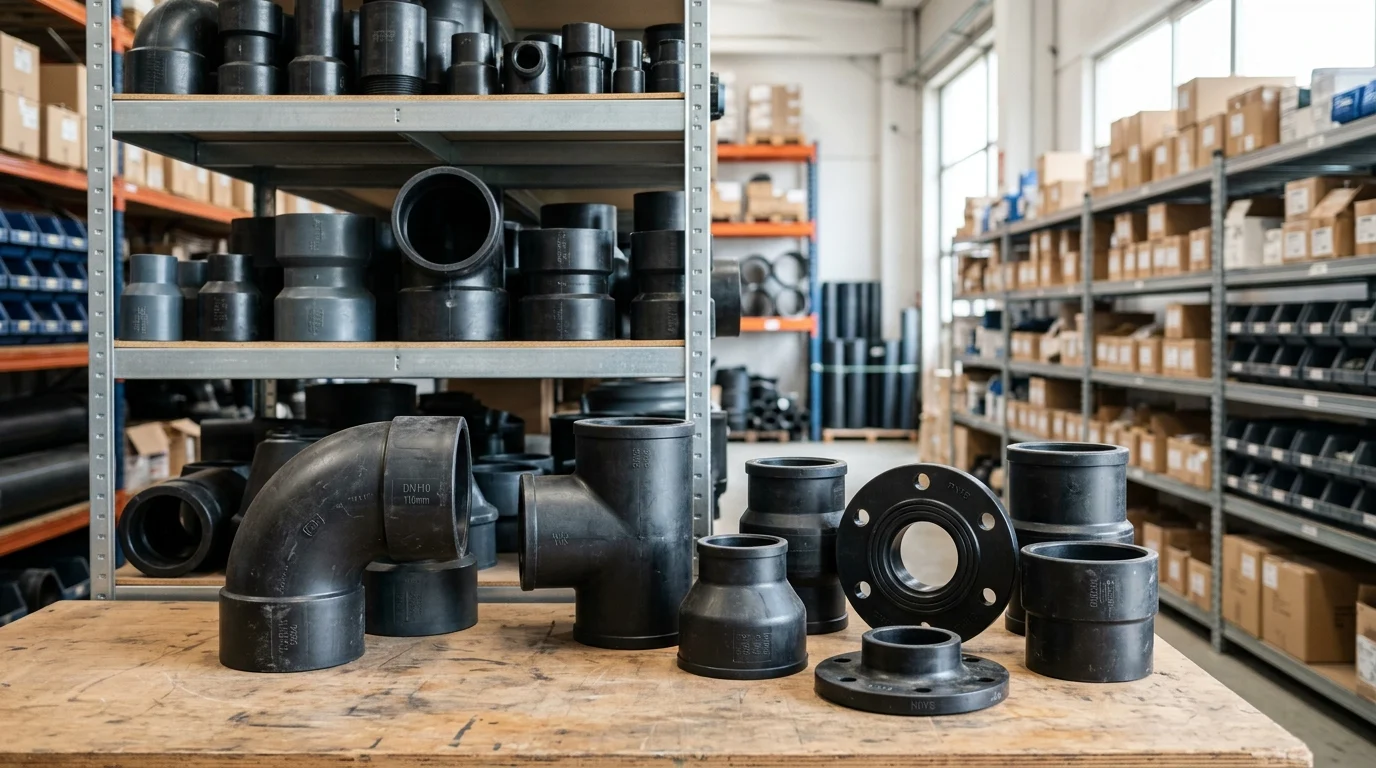
Common industrial fitting types include true union ball valves, sweeping elbows, concentric reducers, and heavy-duty flanges. True union designs are particularly critical in industrial engineering, allowing for in-line maintenance without dismantling the surrounding pipework. The chosen supplier must demonstrate proficiency in molding these complex, multi-part assemblies, ensuring that O-ring grooves and seating surfaces are formed with zero flash and minimal shrinkage.
Technical and Manufacturing Criteria for Evaluating Suppliers

Evaluating a plastic pipe fittings supplier requires a deep dive into their technical capabilities and manufacturing infrastructure. The ability to consistently produce fittings that conform to international specifications depends on the factory's control over raw material sourcing, mold design, and the injection molding process itself. Procurement engineers must look beyond surface-level catalogs and scrutinize the actual manufacturing parameters that dictate the lifespan and safety of the final product.
Material Options and Pressure Ratings
Industrial pipeline fittings are categorized by their Nominal Pressure (PN) or Standard Dimension Ratio (SDR). A qualified supplier must accurately compound materials to meet specific pressure classes, such as PN10 (145 psi) or PN16 (232 psi) for water and chemical applications. In high-density polyethylene (HDPE) systems, a supplier must be adept at transitioning between SDR 11 and SDR 13.6 wall thicknesses while maintaining precise inner and outer diameters.
Material purity is another critical factor. Reputable manufacturers utilize 100% virgin resin sourced from globally recognized petrochemical companies, strictly limiting the use of regrind material to less than 5% for non-critical components, or prohibiting it entirely for high-pressure industrial applications. The melt flow index (MFI) and density of the incoming resin must be verified to ensure uniform flow during the molding process, preventing internal voids or weld line weaknesses.
Quality Control, Testing, and Tooling
Quality control in plastic fitting manufacturing extends far beyond visual inspection. Leading facilities implement rigorous testing protocols, including hydrostatic pressure testing, burst testing, and drop-weight impact testing. Dimensional tolerances for industrial fittings are typically held to ±0.1mm, verified through coordinate measuring machines (CMM) and optical comparators to ensure perfect solvent cement or fusion welding fits.
Tooling quality is the foundation of consistent manufacturing. High-grade injection molds, often machined from premium steel alloys like P20 or S136, are essential for maintaining precision over long production runs. A well-maintained mold in a top-tier Chinese facility can yield upward of 1,000,000 shots before requiring significant refurbishment. Buyers must evaluate the supplier's in-house tooling maintenance program, as degraded molds lead directly to flashing, dimensional drift, and compromised fitting integrity.
Supplier Comparison Framework
To effectively evaluate potential partners, procurement teams should utilize a standardized framework that benchmarks material capabilities against project requirements. The following table illustrates the comparative technical specifications of primary industrial resin systems that a capable supplier must master.
| Resin System | Max Operating Temp (°C) | Tensile Strength (MPa) | Primary Industrial Application |
|---|---|---|---|
| UPVC | 60 | 45 – 55 | Water treatment, general chemical |
| CPVC | 95 | 50 – 60 | Corrosive fluids, commercial hot water |
| PPH | 100 | 30 – 40 | Petrochemical, metallurgy pipelines |
| PVDF | 140 | 40 – 50 | High-purity acids, semiconductor fabs |
Suppliers should be assessed on their ability to provide comprehensive material test reports (MTRs) for each batch of these specific polymers.
Compliance, Certifications, and Total Cost Assessment
In international procurement, the intersection of regulatory compliance and cost management dictates the long-term viability of a supplier relationship. Industrial pipeline components are heavily regulated due to their impact on public health, environmental safety, and structural integrity. Simultaneously, buyers must navigate volatile raw material markets and complex tooling investments to achieve a favorable total cost of ownership (TCO).
Standards, Certifications, and Traceability
A baseline requirement for any industrial supplier is ISO 9001 certification, but pipeline engineering demands specific product-level compliance. Fittings intended for potable water or food-grade processing must carry certifications such as NSF/ANSI 14 and 61, or WRAS. For chemical and industrial applications, adherence to dimensional and performance standards like ASTM D2466 (for Schedule 40 PVC) or DIN 8063 is non-negotiable.
Traceability is equally critical for risk mitigation. Advanced manufacturers implement sophisticated lot tracking systems, etching or molding batch codes directly onto the fittings. This ensures that every component can be traced back to its specific resin batch, molding machine, and production date. Industry best practices require suppliers to maintain these production and quality records for a minimum 10-year retention period, providing accountability in the event of a field failure.
Pricing, Mold Costs, and Raw Material Volatility
Unit pricing for plastic fittings is heavily influenced by global petrochemical indices. Procurement teams should expect a 15% to 20% variance in raw material costs depending on market conditions, and sophisticated buyers often negotiate index-linked contracts to ensure transparent pricing. Beyond the unit price, mold amortization plays a significant role in total cost.
For custom or proprietary fittings, mold opening costs in China typically range from $3,000 to $15,000, depending on the cavity count, core complexity, and required steel grade. Buyers must establish clear agreements regarding mold ownership, maintenance responsibilities, and guaranteed shot life. A supplier offering an exceptionally low unit price but utilizing substandard tooling will ultimately generate higher costs through elevated defect rates and premature mold replacement.
Sourcing, Factory Audit, and Logistics Risk Control
Securing a reliable plastic pipe fittings supplier requires rigorous operational vetting. Supply chain disruptions, inconsistent quality, and delayed shipments can derail multi-million-dollar engineering projects. Conducting thorough factory audits and analyzing the logistical infrastructure of the supplier are mandatory steps in controlling procurement risk.
Supplier Qualification Process
The supplier qualification process should follow international auditing standards, such as ISO 19011. An on-site or third-party audit must evaluate the factory's production capacity, machinery age, and scrap management. A highly efficient injection molding facility should demonstrate a scrap rate of less than 2%, indicative of optimized processing parameters and tight material control.
Auditors should also verify the range of injection molding machinery. Producing large-diameter industrial fittings (e.g., 12-inch flanges or tees) requires high-tonnage machines, often ranging from 800T to 2800T of clamping force, whereas precision valves require smaller, high-speed 90T to 200T machines. A supplier's machinery profile must perfectly align with the buyer's dimensional requirements to prevent outsourcing to unverified sub-tier vendors.
Factory Location, Capacity, and Delivery Planning
China's manufacturing ecosystem is highly regionalized, and a supplier's geographic location directly impacts logistics costs and lead times. Understanding these hubs allows buyers to optimize their shipping strategies and anticipate potential supply chain bottlenecks.
| Manufacturing Hub | Primary Focus & Specialty | Average Port Lead Time |
|---|---|---|
| Zhejiang (Ningbo, Taizhou) | Injection molded UPVC/CPVC, tooling | 1 – 3 days to Ningbo Port |
| Guangdong (Shenzhen, Foshan) | High-precision engineering plastics, PVDF | 1 – 2 days to Yantian Port |
| Shandong (Linyi) | Large diameter HDPE, extrusion | 2 – 4 days to Qingdao Port |
Standard catalog fittings typically require a production lead time of 25 to 35 days. However, custom-molded components or specialized resin systems may extend lead times to 45 to 60 days. Buyers must evaluate the supplier's warehousing capacity and their ability to hold buffer stock for critical, high-turnover items to mitigate transit delays.
Decision Framework for Shortlisting Suppliers
Shortlisting the ideal plastic pipe fittings supplier is a strategic exercise that balances technical capability, compliance, and commercial viability. Procurement teams must synthesize audit data, cost models, and communication metrics to identify partners capable of sustaining a long-term integration into the buyer's supply chain.
Matching Supplier Strengths to Project Needs
Not all capable suppliers are the right fit for every project. A factory optimized for high-volume, standard residential PVC fittings may struggle with the stringent documentation and material traceability required for a chemical processing plant. Conversely, a boutique manufacturer specializing in high-purity PVDF fittings for the semiconductor industry will likely be cost-prohibitive for municipal irrigation projects.
Buyers must map their specific project constraints—such as extreme temperature requirements, aggressive chemical exposure, or strict regulatory compliance—directly to the supplier's core competencies. Requesting case studies or reference clients in similar industrial sectors provides tangible proof of a supplier's ability to execute under relevant engineering constraints.
Final Selection Criteria and Procurement Signals
To finalize the selection, procurement teams typically utilize a weighted supplier scorecard. A standard industrial weighting might allocate 40% to technical capability and quality control, 30% to commercial pricing and mold costs, 20% to logistics and capacity, and 10% to communication and engineering support. This objective framework prevents decisions based solely on the lowest initial quote.
Procurement signals, such as the supplier's willingness to accept standard international payment terms (typically 30% advance via T/T, with the 70% balance against the Bill of Lading), indicate financial stability. Furthermore, a supplier's responsiveness during the RFQ process, the clarity of their technical feedback on part drawings, and their transparency regarding raw material sourcing are strong leading indicators of their reliability as a long-term manufacturing partner.
Key Takeaways
- The most important conclusions and rationale for Plastic Pipe Fittings Supplier for Pipeline Engineering
- Specs, compliance, and risk checks worth validating before you commit
- Practical next steps and caveats readers can apply immediately
Frequently Asked Questions
What plastic fitting materials are best for industrial pipeline engineering?
Use UPVC for general water and mild chemicals, CPVC for higher temperatures, and HDPE for underground or impact-prone lines. Match the resin to media, temperature, and pressure requirements before ordering.
How can I evaluate a Chinese plastic pipe fittings supplier?
Check material traceability, pressure ratings, dimensional tolerance control, and test reports. Prefer suppliers with export experience, responsive engineering support, and stable capacity for bulk industrial orders.
Does Pntek supply integrated piping products beyond fittings?
Yes. Pntek offers pipes, fittings, valves, sprinkler products, and water meters in UPVC, CPVC, PPR, HDPE, and related systems for construction, irrigation, and water supply projects.
Why are true union valves important in industrial piping systems?
They allow fast in-line maintenance without cutting surrounding pipe. This reduces downtime, simplifies replacement, and is especially useful in chemical, water treatment, and high-use process lines.
Can Pntek support export and quotation needs for infrastructure buyers?
Yes. Pntek positions itself for global service with export experience, quick consultation, and responsive quote support, which helps buyers manage large water transport and underground pipeline projects more efficiently.


