
Introduction
Selecting a reliable CPVC valve manufacturer is a critical decision in any corrosive liquid system, where chemical exposure, temperature, and uptime requirements leave little margin for error. The right supplier affects more than component quality: it influences chemical compatibility, sealing performance, maintenance intervals, and overall system safety. This article explains what distinguishes a capable manufacturer, how production quality translates into valve reliability, and which evaluation criteria matter most for industrial applications. By the end, readers will have a practical framework for comparing manufacturers and choosing CPVC valves that support long-term performance in demanding process environments.
Why the right CPVC valve manufacturer matters
Chlorinated Polyvinyl Chloride (CPVC) is a foundational material in industrial fluid handling, specifically engineered to transport highly corrosive chemicals at elevated temperatures. Unlike standard PVC, which is limited to 140°F (60°C), CPVC can sustain operational integrity up to 200°F (93°C). Partnering with an expert CPVC valve manufacturer ensures that these critical flow control components are molded and assembled to exacting tolerances, directly impacting the safety, longevity, and efficiency of the entire piping network.
Downtime risk, chemical compatibility, and total installed cost
The operational stakes in corrosive fluid handling are exceptionally high. A single valve failure in a concentrated acid line can trigger catastrophic plant downtime, environmental liabilities, and severe safety hazards. When engineers evaluate total installed cost (TIC), the initial purchase price of a valve represents only a fraction of its lifecycle expense. Inferior valves prone to premature seal degradation or stem failure inflate maintenance budgets and introduce unacceptable downtime risks. High-quality CPVC valves mitigate these risks by providing superior chemical compatibility, ensuring that aggressive media such as sodium hypochlorite, sulfuric acid, and hydrochloric acid do not compromise the structural integrity of the flow control system over years of continuous operation.
Industries that rely most on CPVC valves
Specific sectors rely heavily on industrial-grade CPVC valves due to the aggressive nature of their process fluids. In the chlor-alkali industry, pipelines routinely transport brine and caustic soda, requiring valves that resist both internal chemical attack and external corrosive atmospheres. Metal finishing and electroplating facilities rely on CPVC to handle plating baths and wastewater containing heavy metals and acids, often at temperatures exceeding 160°F (71°C). Additionally, commercial water treatment plants utilize CPVC valves for chemical dosing systems, where precise, leak-free control of disinfectants and coagulants is mandatory for maintaining strict regulatory compliance.
Technical criteria for evaluating a CPVC valve manufacturer
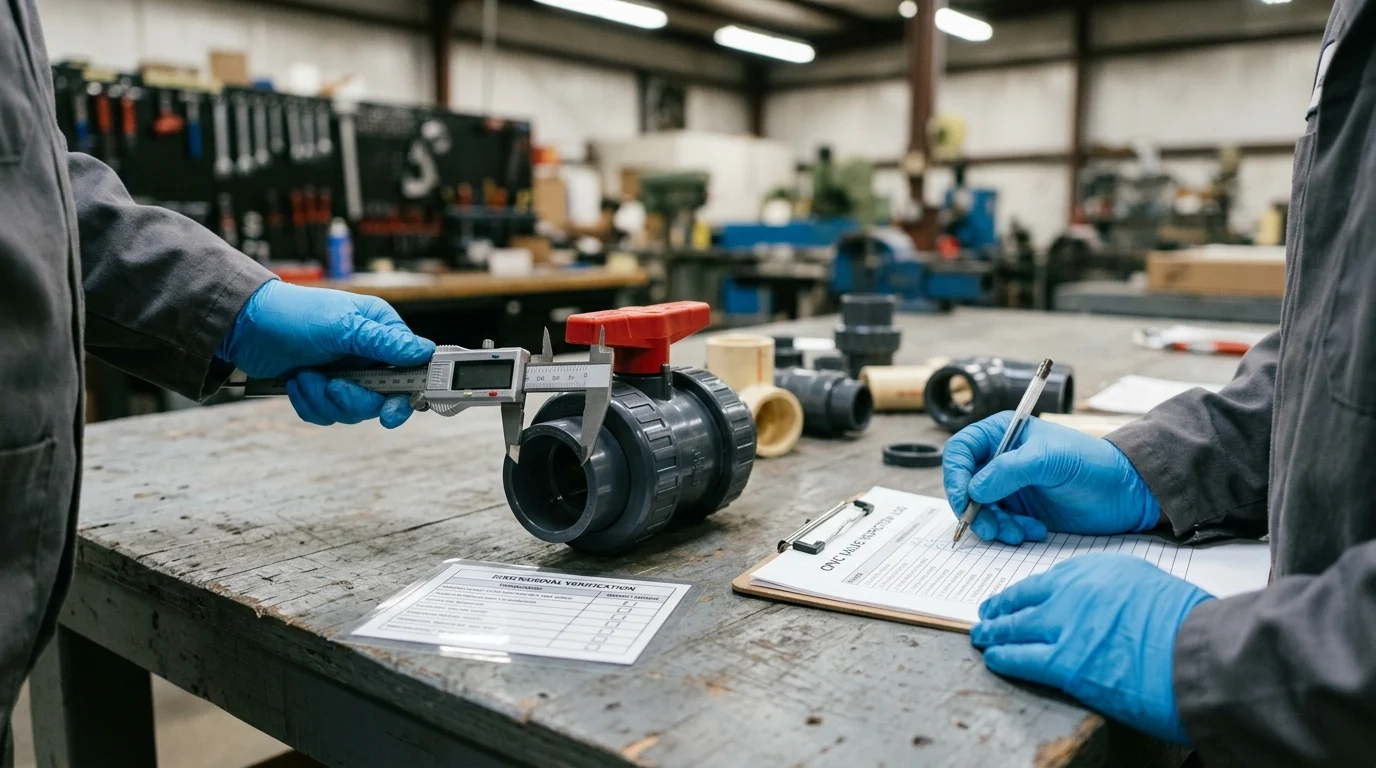
Engineering procurement requires a granular analysis of a manufacturer’s technical capabilities. The manufacturer must demonstrate strict adherence to international standards governing plastic piping components, ensuring that every valve produced can withstand the stated mechanical and thermal loads without deformation or catastrophic failure.
Material, pressure, temperature, and sealing specifications
Industrial CPVC valves must conform strictly to material and mechanical specifications. Premium valves are molded from CPVC resin meeting ASTM D1784 Cell Class 23447 or 24448, guaranteeing specific tensile strength, modulus of elasticity, and heat deflection properties. Pressure ratings are critical; a standard industrial CPVC ball valve should offer a rating of at least 150 PSI at 73°F (23°C) for water, with clearly defined derating factors as temperatures approach the 200°F maximum. Sealing technology is equally paramount. Manufacturers must offer varied elastomer options—typically EPDM for basic chemical resistance and FKM (fluoroelastomer) for aggressive acids and halogens—paired with robust PTFE (Teflon) seats to ensure a bubble-tight shutoff under varying pressure differentials.
Chemical resistance data and performance documentation
Evaluating a manufacturer requires deep scrutiny of their chemical resistance data and performance documentation. Reputable suppliers provide comprehensive chemical resistance charts that map their specific CPVC formulation and elastomer combinations against hundreds of industrial chemicals at varying concentrations and temperatures. For example, a valve handling 70% sulfuric acid requires vastly different sealing considerations than one managing 10% sodium hypochlorite. Furthermore, engineers must request pressure-temperature (P-T) derating curves. A valve rated for 150 PSI at ambient temperature may only safely handle 30 PSI at 180°F (82°C). Manufacturers lacking this documented, empirical data introduce significant engineering risk into the system design.
A practical comparison table for CPVC valve options
To streamline the evaluation of CPVC valve configurations, engineers must compare the properties of standard sealing materials utilized by the manufacturer. The table below outlines the primary distinctions in seal and seat specifications commonly requested in industrial applications.
| Component / Material | Maximum Operating Temperature | Optimal Chemical Compatibility | Relative Cost Factor |
|---|---|---|---|
| EPDM O-Rings | 200°F (93°C) | Alkaline solutions, dilute acids, ketones | Baseline (1.0x) |
| FKM O-Rings | 200°F (93°C) | Concentrated acids, halogenated hydrocarbons | Premium (1.5x – 2.0x) |
| PTFE Seats | 200°F+ (exceeds CPVC limit) | Universal chemical resistance, low friction | Standard included |
| FEP-Encapsulated | 200°F (93°C) | Ultra-pure applications, aggressive mixed media | High (2.5x+) |
How to assess quality, compliance, and supply reliability
Beyond baseline material specifications, the operational maturity of a CPVC valve manufacturer dictates the long-term viability of the supply chain. Buyers must assess the vendor’s quality assurance frameworks and production infrastructure to ensure that a valve purchased today performs identically to one purchased three years from now.
Certifications, testing protocols, and traceability
Top-tier manufacturers maintain rigorous quality management systems, typically anchored by ISO 9001:2015 certification. For industrial valves, testing protocols must be exhaustive. Industry best practices dictate 100% hydrostatic testing of every valve before it leaves the facility, often at 1.5 times the maximum working pressure (e.g., testing a 150 PSI valve at 225 PSI) to verify shell integrity and seat leak-tightness. Furthermore, traceability is non-negotiable in critical applications. Manufacturers should provide batch numbers molded directly into the valve body, allowing end-users to trace the specific lot of CPVC resin, the date of manufacture, and the corresponding quality control test reports in the event of a field failure.
Tooling capability, batch consistency, and lead times
The physical manufacturing infrastructure directly influences batch consistency and supply reliability. High-quality injection molding tooling represents a massive capital investment; molds engineered from hardened steel can withstand upwards of 500,000 to 1,000,000 shots, ensuring dimensional stability across large production runs. If a manufacturer uses inferior aluminum tooling, dimensional drift will eventually lead to sticking stems or leaking union nuts. Additionally, buyers must audit lead times. Vertically integrated manufacturers may offer standard lead times of 4 to 6 weeks, whereas relying on heavily outsourced production networks can extend lead times to 14 to 18 weeks, complicating inventory management and project scheduling.
Best sourcing and selection process for CPVC valve buyers
Strategic procurement of CPVC valves requires a methodical approach that aligns engineering prerequisites with commercial realities. Establishing a reliable supply chain involves moving beyond basic catalog browsing to engage in structured vetting, rigorous testing, and commercial negotiation.
Procurement and engineering evaluation steps
A robust evaluation process bridges the gap between procurement teams and engineering departments. The process begins with a detailed Request for Quotation (RFQ) that specifies valve types, sizes (typically ranging from 1/2-inch to 6-inch for standard industrial pipelines), connection types (flanged, threaded, or socket), and required seal materials. Once initial proposals are received, engineering teams must conduct prototype evaluations. This involves acquiring sample valves and subjecting them to cycle testing—often requiring a minimum of 10,000 to 25,000 open/close cycles under simulated pressure—to validate torque consistency and wear resistance over an accelerated lifespan.
Comparing pricing, MOQ, customization, and private labeling
Commercial viability hinges on aligning pricing structures, Minimum Order Quantities (MOQs), and customization capabilities. For standard, off-the-shelf CPVC valves, MOQs might be as low as a single pallet. However, OEMs and large distributors often require custom solutions, such as specific handle colors, specialized lock-out/tag-out (LOTO) mechanisms, or private labeling molded into the valve body. These customizations typically demand higher MOQs, often ranging from 500 to 2,000 units per size, to offset tooling modifications and setup costs. Buyers must weigh the unit cost savings of high-volume orders against inventory carrying costs and the manufacturer’s ability to hold safety stock.
Warning signs when evaluating a manufacturer
Recognizing red flags early in the auditing process prevents costly supply chain disruptions. A major warning sign is the excessive use of re-grind resin. While utilizing a small percentage of recycled CPVC (under 5%) is standard industry practice to minimize waste, manufacturers exceeding this threshold severely compromise the pressure rating and impact resistance of the final product. Another red flag is a lack of in-house tooling maintenance. If a manufacturer relies entirely on third-party tool shops for mold repairs, even minor defects can halt production for weeks. Finally, evasiveness regarding raw resin sourcing or an inability to produce material test reports (MTRs) indicates a dangerous lack of process control.
A decision framework for shortlisting CPVC valve manufacturers
Finalizing a supply chain partnership requires synthesizing all technical, quality, and commercial data into a cohesive decision framework. This ensures that the chosen manufacturer can reliably support the operational demands of the end-user or distributor over the long term without introducing unforeseen systemic risks.
Balancing technical fit, compliance, and supplier risk
A structured evaluation framework standardizes the comparison of multiple CPVC valve manufacturers. Procurement teams typically utilize a weighted scoring matrix to balance competing priorities. For example, a rigorous industrial application might assign a 40% weight to technical specifications and chemical resistance data, a 30% weight to quality assurance and traceability protocols, and a 30% weight to commercial terms like pricing and lead times. This objective approach prevents buyers from defaulting to the lowest-cost provider, a common pitfall that ignores the severe financial risks of supplier insolvency, delayed shipments, or catastrophic in-field valve failures.
Final selection criteria
The culmination of the sourcing process is the application of final selection criteria. By establishing strict minimum thresholds for performance, buyers can filter out unqualified vendors and select a partner capable of delivering consistent, high-yield manufacturing.
| Evaluation Category | Key Metric | Minimum Acceptable Threshold |
|---|---|---|
| Material Integrity | Re-grind resin usage | < 5% of total formulation |
| Quality Assurance | Hydrostatic test yield | 100% testing with > 99.5% pass rate |
| Supply Chain | On-time delivery (OTD) rate | > 95% over a trailing 12-month period |
| Traceability | Lot code availability | MTRs and lot codes on 100% of industrial units |
| Commercial Fit | Standard lead time | < 8 weeks for non-custom configurations |
Key Takeaways
- The most important conclusions and rationale for CPVC valve manufacturer
- Specs, compliance, and risk checks worth validating before you commit
- Practical next steps and caveats readers can apply immediately
Frequently Asked Questions
What makes a reliable CPVC valve manufacturer for corrosive systems?
Look for ASTM-grade CPVC material, clear pressure-temperature derating data, chemical compatibility charts, and proven sealing options like PTFE seats with EPDM or FKM seals.
Which industries commonly use industrial CPVC valves?
CPVC valves are widely used in water treatment, chemical dosing, electroplating, chlor-alkali processing, and other systems handling hot or corrosive liquids.
How do I choose the right seal for a CPVC valve?
Use EPDM for many water, alkaline, and dilute acid services; choose FKM for more aggressive acids and halogen-related chemicals after checking compatibility data.
What temperature and pressure should I verify before ordering?
Confirm the valve’s maximum temperature, base pressure rating, and the manufacturer’s derating curve, since allowable pressure drops as operating temperature rises.
Can Pntek support export buyers needing integrated plastic flow products?
Yes. Pntek supplies CPVC valves plus pipes and fittings, helping irrigation, construction, and infrastructure buyers source matched plastic system components with quote support.


