
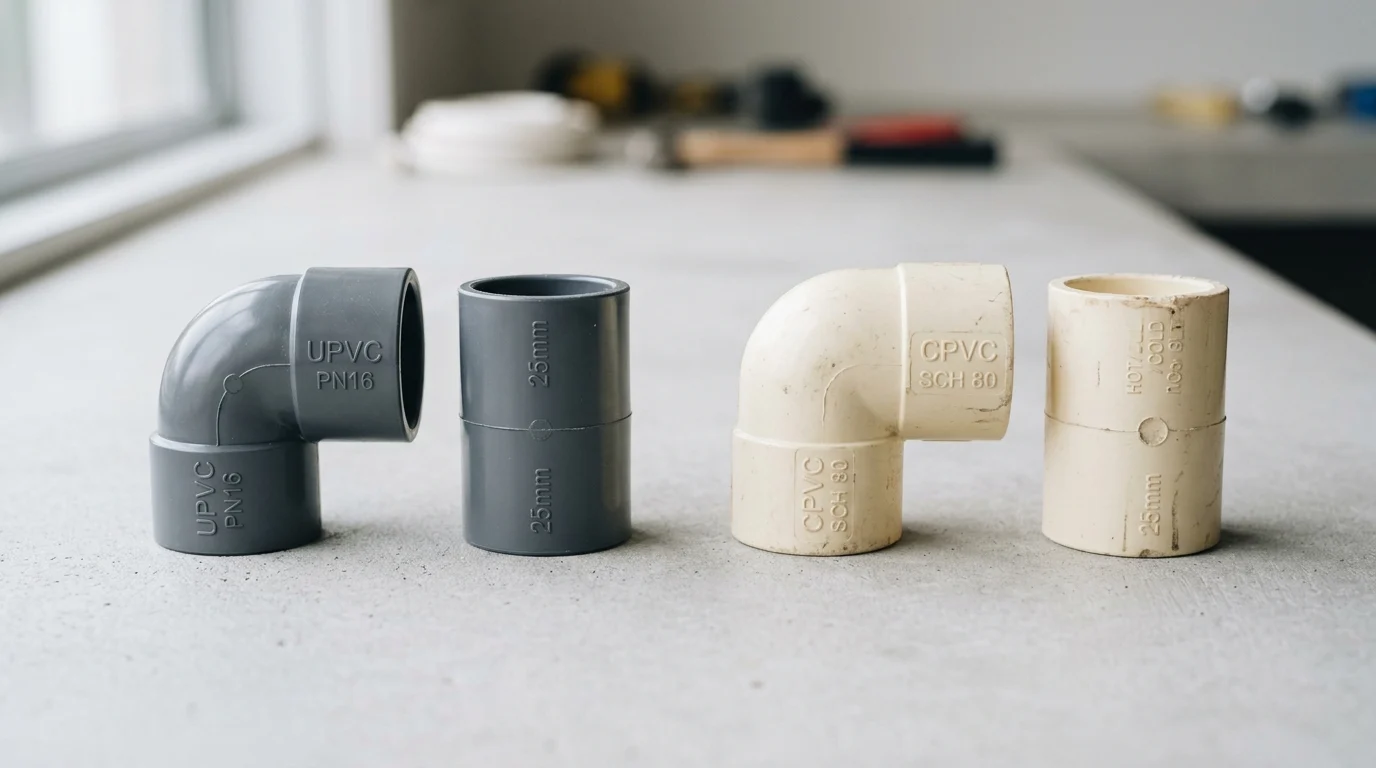
Introduction
Selecting between UPVC and CPVC pipe fittings affects far more than material cost in an industrial plumbing system. Although both are PVC-based thermoplastics, they differ in temperature tolerance, pressure performance, chemical resistance, and long-term reliability under demanding operating conditions. The right choice can improve service life and safety margins, while the wrong one can lead to premature failure, maintenance issues, or unnecessary overspending. This article compares UPVC and CPVC fittings through the practical factors that matter most in industrial projects, helping you match each material to process requirements, installation conditions, and overall project objectives.
Why the UPVC vs CPVC fittings choice matters
In industrial plumbing and fluid handling systems, specifying the correct thermoplastic material is a critical engineering decision that directly impacts system longevity, safety, and capital expenditure. Unplasticized Polyvinyl Chloride (UPVC) and Chlorinated Polyvinyl Chloride (CPVC) represent two of the most widely utilized materials in commercial and industrial piping networks. While they share a foundational polymer chemistry, their distinct molecular structures yield vastly different performance envelopes.
Engineers and procurement specialists must navigate these differences carefully. Failing to accurately match the fitting material to the operational parameters of a system can result in catastrophic pressure boundary failures, chemical leaching, or premature material degradation. The choice between UPVC and CPVC fittings extends beyond mere material preference; it dictates the operational boundaries of the entire process line.
Project temperature, pressure, and chemical exposure
The primary technical differentiators between UPVC and CPVC fittings are their maximum operating temperatures and pressure handling capabilities at elevated thermal states. Industrial applications often operate at the margins of material specifications. UPVC fittings are strictly rated for a maximum continuous operating temperature of 140°F (60°C). Beyond this threshold, the thermoplastic undergoes rapid softening, leading to a severe reduction in pressure-bearing capacity and structural integrity.
In contrast, CPVC fittings are engineered to withstand continuous operating temperatures up to 200°F (93°C). This extended thermal range makes CPVC the mandatory choice for hot water distribution, high-temperature chemical processing, and condensate return lines. Furthermore, chemical exposure profiles differ slightly; while both materials exhibit excellent resistance to a broad spectrum of acids, bases, and salts, CPVC generally maintains its chemical resistance at higher temperatures where UPVC would begin to degrade or swell.
Lifecycle cost, downtime risk, and installation productivity
Total Cost of Ownership (TCO) models heavily influence the specification process. CPVC fittings typically command a 30% to 50% upfront cost premium over equivalent UPVC fittings due to the more complex manufacturing and chlorination processes required. However, in industrial environments where unplanned downtime can incur costs exceeding $10,000 per hour, over-specifying to CPVC provides a robust safety margin against thermal excursions.
Installation productivity remains relatively symmetrical between the two materials, as both utilize solvent cement welding techniques. Yet, lifecycle costs diverge significantly if a system is subjected to temperature fluctuations. A UPVC system exposed to temperatures approaching its 140°F limit will experience accelerated thermal aging and require more frequent inspection and replacement, ultimately neutralizing its initial capital cost advantage.
Material and performance differences between UPVC and CPVC
Understanding the performance disparities between UPVC and CPVC requires examining their underlying polymer chemistry. The physical and thermal properties of these thermoplastics are dictated by their halogenation levels, which govern how the polymer chains interact under mechanical and thermal stress.
Composition, temperature limits, and pressure performance
UPVC is formulated without plasticizers, yielding a rigid, high-strength material with a base chlorine content of approximately 57%. CPVC is produced by subjecting PVC resin to a post-polymerization chlorination reaction, increasing the total chlorine mass fraction to between 63% and 69%. This additional bulky chlorine atom on the polymer backbone restricts chain mobility, thereby significantly elevating the glass transition temperature (Tg) of the material.
This molecular difference profoundly affects pressure derating. Thermoplastic pressure ratings are established at an ambient baseline of 73°F (23°C). As fluid temperature increases, the pressure rating must be mathematically derated. At 140°F, UPVC retains only 22% of its baseline pressure rating. Conversely, CPVC retains approximately 40% to 50% of its pressure rating at 140°F, and continues to offer viable pressure containment up to 200°F, where it still retains roughly 20% of its baseline capacity.
Chemical resistance, corrosion, and water quality
Both UPVC and CPVC are inherently inert to most inorganic chemicals, making them superior to metallic fittings in corrosive environments. They do not suffer from galvanic corrosion, pitting, or scaling. However, CPVC's higher temperature tolerance allows it to transport highly concentrated corrosive fluids—such as sulfuric acid, sodium hypochlorite, and caustic soda—at temperatures that would compromise UPVC.
Regarding water quality, both materials are routinely certified to NSF/ANSI 61 standards for potable water components. Because UPVC lacks plasticizers (unlike flexible PVC), it does not leach phthalates or heavy metals into the fluid stream. CPVC shares this high purity profile, making both materials highly suitable for reverse osmosis (RO) systems, deionized (DI) water lines, and food-grade fluid processing, provided the specific solvent cements used also meet the necessary purity standards.
UPVC vs CPVC comparison table
The following table summarizes the critical material properties and performance limits of UPVC and CPVC fittings to aid in engineering specification:
| Property / Specification | UPVC Fittings | CPVC Fittings |
|---|---|---|
| Maximum Operating Temperature | 140°F (60°C) | 200°F (93°C) |
| Base Chlorine Content | ~57% | 63% – 69% |
| Tensile Strength (at 73°F) | 7,200 psi | 8,200 psi |
| Coefficient of Thermal Expansion | 3.0 x 10^-5 in/in/°F | 3.8 x 10^-5 in/in/°F |
| Relative Material Cost Baseline | 1.0x | 1.5x – 2.0x |
Installation, compliance, and total project cost
Moving from engineering theory to site execution, the installation protocols, regulatory compliance, and economic variables of UPVC and CPVC systems dictate the ultimate success of an industrial plumbing project. While the physical actions required to join the pipes and fittings are visually identical, the chemical formulations and curing mechanics are strictly segregated.
Joining methods, workmanship, and maintenance
Both UPVC and CPVC fittings rely on solvent cement welding, a process that chemically fuses the pipe and fitting into a single monolithic structure. However, the cements are not interchangeable. UPVC requires cements conforming to ASTM D2564, while CPVC demands cements meeting ASTM F493. Using UPVC cement on a CPVC fitting will result in a weak joint prone to blowout under pressure.
Workmanship and environmental conditions heavily influence joint integrity. Curing times are highly dependent on ambient temperature, humidity, and pipe diameter. For instance, a 4-inch CPVC joint assembled at 60°F requiring a test pressure of 150 psi demands a minimum cure time of 48 hours before pressurization. Maintenance teams must account for these extended cure times during emergency shutdowns to avoid premature pressurization and subsequent joint failure.
Codes, standards, and certifications
Industrial piping systems must adhere to rigorous international codes. UPVC fittings are typically manufactured to meet ASTM D2466 (Schedule 40) and ASTM D2467 (Schedule 80) dimensional and burst strength standards. CPVC fittings are governed by ASTM F437, F438, and F439.
For process piping, engineers must ensure the assembled system complies with ASME B31.3 standards. Furthermore, fire safety codes often favor CPVC in specific indoor applications; CPVC has a remarkably high limiting oxygen index (LOI) of 60, meaning it requires 60% oxygen in the atmosphere to sustain a flame, making it self-extinguishing and compliant with stringent commercial fire codes.
Material price, labor, availability, and replacement cost
The total project cost is a function of material price, labor rates, and future replacement liabilities. Labor costs for installing UPVC and CPVC are effectively identical, as the time required to cut, chamfer, prime, and glue a joint does not change between the two materials. Assuming an industrial pipefitter labor rate of $85 per hour, the installation cost per linear foot remains constant.
The divergence lies in the material procurement. CPVC fittings carry a 1.5x to 2.0x price multiplier over UPVC. However, if UPVC is mistakenly installed in a high-temperature washdown line, the replacement cost—factoring in facility downtime, labor for demolition, and the purchase of the correct CPVC materials—will eclipse the initial savings by an order of magnitude.
Procurement and quality control for UPVC and CPVC fittings
Procuring industrial-grade thermoplastic fittings requires stringent quality control and a deep understanding of global supply chain dynamics. Not all fittings manufactured to ASTM standards exhibit the same level of reliability; variances in injection molding processes and resin quality can introduce hidden vulnerabilities into a fluid handling system.
Supplier capability and dimensional consistency
Supplier capability is paramount when sourcing UPVC and CPVC fittings. The integrity of a solvent-welded joint relies on an exact interference fit between the pipe outside diameter and the fitting socket inside diameter. Top-tier manufacturers maintain dimensional tolerances within ±0.005 inches during the injection molding process.
Quality control protocols must include batch testing for burst pressure, dimensional stability, and resin purity. For critical industrial applications, procurement engineers should mandate that suppliers demonstrate a defect rate below 0.1% (1000 Parts Per Million). Inferior fittings molded from regrind (recycled) resin rather than virgin resin will exhibit compromised tensile strength and higher failure rates under dynamic pressure spikes.
Logistics, packaging, and regional supply factors
Logistics and handling play a frequently overlooked role in the quality of CPVC and UPVC systems. CPVC, due to its higher chlorine content, is inherently more brittle than UPVC at lower ambient temperatures before it is installed and pressurized. Impact damage during transit is a significant risk.
When shipping CPVC fittings during winter months where ambient temperatures drop below 20°F (-6°C), specialized packaging or temperature-controlled logistics may be necessary to prevent micro-fracturing. Regional supply factors also dictate availability; while UPVC is ubiquitously stocked globally, large-diameter (over 6-inch) Schedule 80 CPVC fittings may require lead times of 8 to 12 weeks, necessitating accurate forecasting by project managers.
Decision framework for choosing UPVC vs CPVC
Establishing a definitive decision framework removes the ambiguity from selecting between UPVC and CPVC fittings. By systematically evaluating operational parameters against material capabilities, engineering teams can optimize both system safety and capital expenditure.
Step-by-step selection process
The selection process must follow a strict, sequential engineering evaluation. First, identify the absolute maximum continuous and peak operating temperatures of the fluid. Second, calculate the required system pressure at that maximum temperature and apply the specific material's thermal derating factor. Third, cross-reference the chemical composition of the fluid with the manufacturer's chemical compatibility charts for both UPVC and CPVC.
Finally, evaluate the ambient environmental conditions of the installation site. If the piping is exposed to direct sunlight, radiant heat from adjacent machinery, or extreme cold, these external factors must be integrated into the derating calculations.
| Application Parameter | UPVC Recommendation | CPVC Recommendation |
|---|---|---|
| Continuous Temp < 140°F | Highly Recommended | Over-specified (costly) |
| Continuous Temp 140°F – 200°F | Unsafe (High Failure Risk) | Highly Recommended |
| Aggressive Acids at Ambient Temp | Excellent | Excellent |
| Aggressive Acids at 160°F | Unsuitable | Excellent |
| Strict Budget Constraints | Preferred | Secondary Option |
When UPVC is the better choice and when CPVC is preferable
UPVC remains the superior choice for chilled water systems, low-pressure wastewater management, irrigation, and chemical dosing lines operating strictly below 140°F (60°C). Its lower cost, robust impact resistance at ambient temperatures, and widespread availability make it the workhorse of standard industrial plumbing.
Conversely, CPVC is the indispensable choice—and often the legally mandated standard—for hot water distribution, condensate lines, and aggressive chemical processing environments where temperatures exceed 140°F. When the thermal parameters of a project push the limits of standard thermoplastics, investing the 1.5x to 2.0x cost premium for CPVC fittings is the only reliable method to ensure a leak-free, compliant, and durable industrial piping system.
Key Takeaways
- The most important conclusions and rationale for UPVC vs CPVC fittings
- Specs, compliance, and risk checks worth validating before you commit
- Practical next steps and caveats readers can apply immediately
Frequently Asked Questions
When should I choose CPVC over UPVC fittings?
Choose CPVC when fluid temperatures can exceed 140°F (60°C) or when hot, corrosive media are present. For cooler water and general chemical service, UPVC is often the more economical option.
What is the main temperature difference between UPVC and CPVC fittings?
UPVC is typically limited to 140°F (60°C), while CPVC can handle continuous service up to 200°F (93°C). Always check pressure derating at your actual operating temperature.
Are UPVC fittings cheaper than CPVC fittings?
Yes. UPVC usually has a lower upfront cost, while CPVC costs more but reduces risk in high-temperature industrial lines where failure or downtime would be expensive.
Can Pntek supply matching pipes, valves, and fittings for these systems?
Yes. Pntek offers integrated plastic piping solutions, including UPVC, CPVC, valves, and related fittings, which helps buyers source compatible components from one supplier.
How do I request the right fitting recommendation for my project?
Send your medium, temperature, pressure, pipe size, and application details to Pntek for a quick quote and material suggestion. This helps avoid under-specifying UPVC where CPVC is required.


