
Introduction
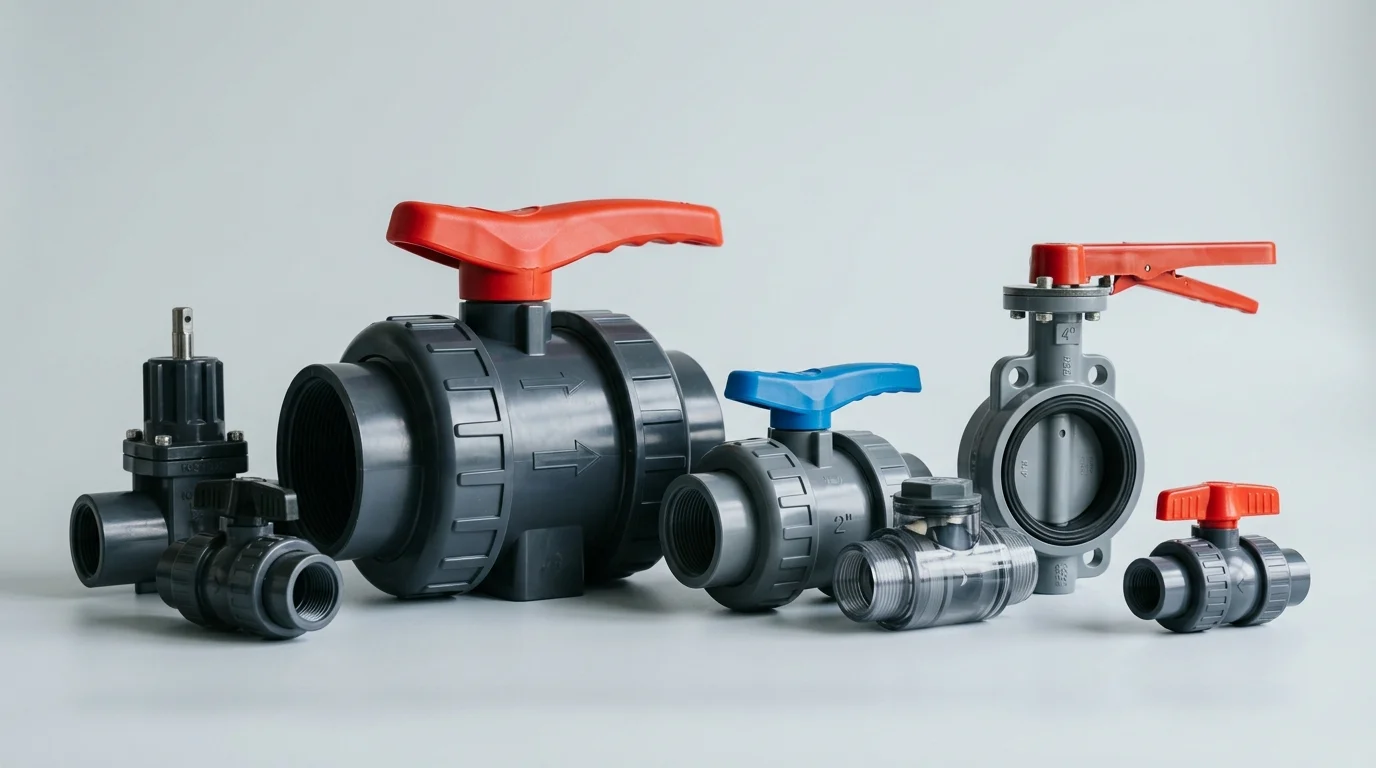
PVC ball valves are common shutoff devices in water systems because they offer a simple way to start, stop, or isolate flow without the corrosion problems associated with many metal components. Made from rigid plastic and built around a rotating internal ball, they are widely used in irrigation, water treatment, and commercial plumbing where chemical resistance, low maintenance, and cost control matter. This article explains what PVC ball valves are, how their internal mechanism opens and closes water flow, and why their material properties make them a practical choice for many modern piping systems.
Why PVC ball valves matter in water systems
Plastic valves for water systems are critical infrastructure components across industrial, municipal, and commercial fluid handling networks. Among these, PVC (polyvinyl chloride) ball valves stand out as a primary mechanism for flow control, combining robust chemical resistance with highly efficient manufacturing economics. As infrastructure ages and metal degradation accelerates, operators are increasingly shifting toward engineered polymer solutions to maintain fluid integrity and system longevity.
Key use cases and value drivers
The primary utility of PVC ball valves lies in their exceptional resistance to scaling, pitting, and galvanic corrosion—issues that persistently plague metallic piping systems. Industrial water treatment plants, agricultural irrigation networks, and commercial plumbing systems rely heavily on these valves to isolate flow without risking contamination from rust or heavy metal leaching. Unplasticized PVC (uPVC), the standard rigid formulation used in these applications, delivers a smooth internal bore that minimizes friction loss and prevents the buildup of biological or mineral deposits over time.
Operating and commercial pressures
Commercial pressures also drive the transition toward plastic valves for water systems. From a procurement standpoint, the cost differential is substantial: a standard 2-inch true union PVC ball valve typically costs between $15 and $45, whereas a comparable stainless steel 316 valve often ranges from $80 to over $150. Furthermore, supply chain dynamics favor PVC; lead times for bulk polymer valves generally hover around 2 to 4 weeks, compared to the 8 to 12 weeks frequently required for specialized metal alloy valves. This combination of reduced capital expenditure and rapid availability allows facility managers to optimize maintenance budgets while accelerating project timelines.
What PVC ball valves are and how they work
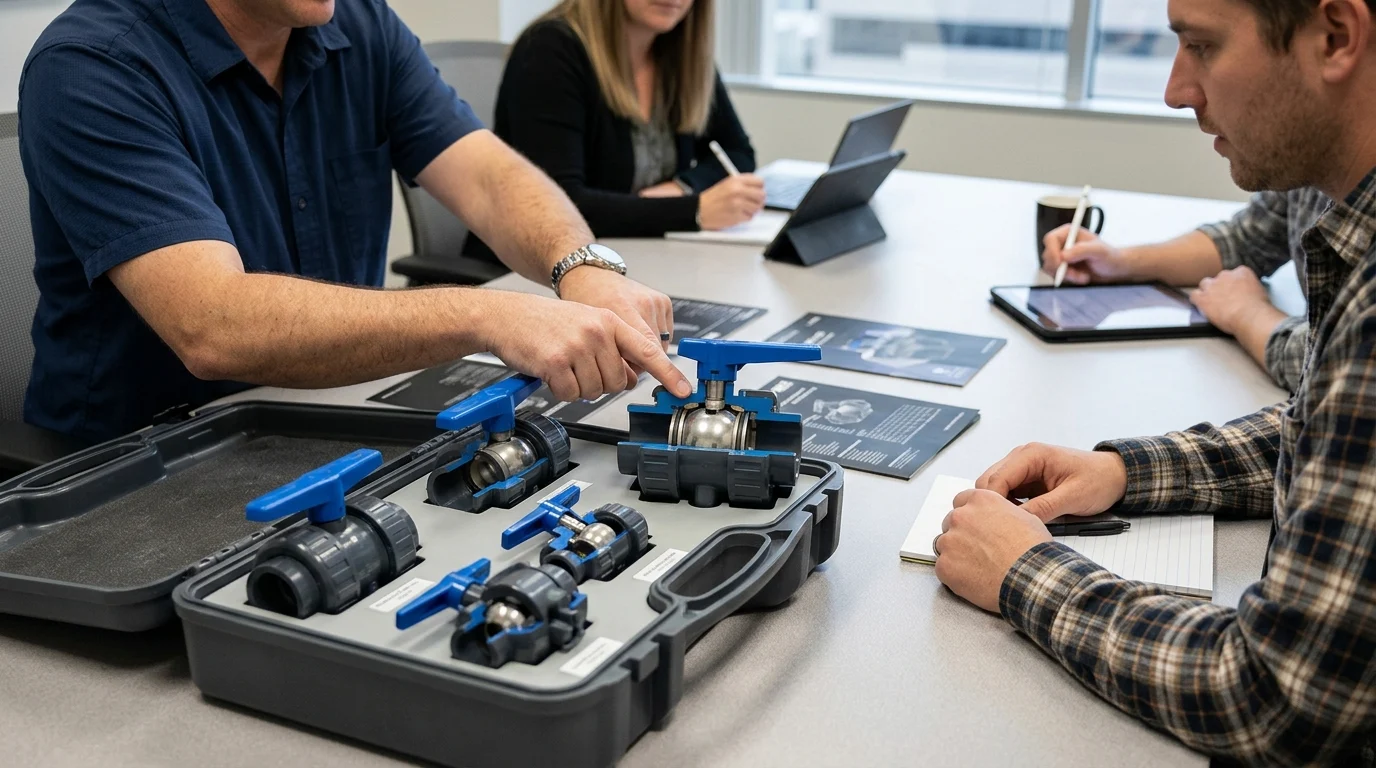
At the most fundamental level, PVC ball valves function as rotary motion valves that use a spherical disc to stop or start fluid flow. The simplicity of this mechanism is central to its reliability, ensuring that water systems can be isolated quickly during maintenance or emergency shutoffs.
Core components and construction
The construction of a PVC ball valve involves several precision-molded components. The external body houses the internal ball, which features a cylindrical hole, or port, running through its center. To ensure a watertight seal, the ball is suspended between two seats, typically manufactured from PTFE (Polytetrafluoroethylene or Teflon). Elastomeric O-rings—most commonly made from EPDM (Ethylene Propylene Diene Monomer) or FPM/FKM (fluorocarbon rubber)—are strategically placed around the stem and end connectors to prevent external leakage. The stem connects the internal ball to the external handle, translating manual or automated torque into mechanical actuation.
Quarter-turn operation and flow control
Flow control is achieved through quarter-turn operation. Rotating the handle exactly 90 degrees aligns the ball’s internal port with the pipeline to permit flow, or positions it perpendicular to completely obstruct the passage of water. This rapid actuation is highly advantageous in emergency scenarios. Furthermore, most industrial PVC ball valves feature a full-port design, meaning the internal bore of the ball matches the internal diameter of the pipe. This configuration results in exceptionally high flow coefficients; for example, a standard 1-inch full-port PVC ball valve typically achieves a Cv value of approximately 120 GPM at a 1 PSI pressure drop, ensuring minimal disruption to system hydraulics.
Common design variants
Manufacturers produce several design variants to accommodate different operational constraints. The true union or double-block design is the industry standard for industrial applications, featuring threaded union nuts on both ends that allow the central valve body to be removed from the pipeline without cutting the pipe. Conversely, compact or utility ball valves are single-piece units designed for low-cost, light-duty applications where inline maintenance is not required. Single-union designs offer a middle ground, providing a disconnect point on one side of the valve, which is frequently used at the termination points of water tanks or pump stations.
How PVC ball valves compare with other valve options
Selecting the appropriate valve material requires a rigorous evaluation of system parameters. While PVC remains the dominant polymer for ambient-temperature water, comparing it against other materials reveals clear operational boundaries.
Key comparison criteria
The primary criteria for comparing valve materials include maximum operating temperature, pressure rating, tensile strength, and chemical compatibility.
| Material | Max Operating Temp | Typical Pressure Rating (at 73°F) | Relative Cost Index | Primary Advantage |
|---|---|---|---|---|
| PVC | 140°F (60°C) | 150 – 235 PSI | 1.0x (Baseline) | Highly cost-effective, excellent corrosion resistance |
| CPVC | 200°F (93°C) | 150 – 235 PSI | 1.5x – 2.0x | Higher temperature threshold |
| Brass | 400°F+ (204°C+) | 400 – 600 PSI | 3.0x – 4.0x | High mechanical strength and pressure tolerance |
| Stainless Steel (316) | 400°F+ (204°C+) | 1000+ PSI | 5.0x – 8.0x | Extreme pressure and chemical durability |
Best-fit applications
PVC ball valves are the ideal solution for cold water distribution, municipal wastewater processing, and chemical dosing systems where fluids remain at ambient temperatures. They are particularly dominant in reverse osmosis (RO) and deionized (DI) water systems. In these high-purity applications, metallic valves are prone to leaching ions into the water, whereas unplasticized PVC maintains strict fluid purity without degrading.
Main trade-offs and limitations
The primary limitation of PVC is its thermal sensitivity. PVC valves are strictly rated for a maximum operating temperature of 140°F (60°C). As temperatures rise, the material’s tensile strength decreases significantly, requiring a mandatory derating of the allowable pressure. For instance, a Schedule 80 PVC ball valve rated for 150 PSI at 73°F will safely handle only about 33 PSI when operating at 140°F. Additionally, PVC becomes brittle at freezing temperatures, making it susceptible to cracking if water expands into ice within the valve body. In applications demanding high pressure, high heat, or extreme mechanical stress, metallic valves or CPVC (Chlorinated Polyvinyl Chloride) must be specified.
Installation, compliance, and maintenance best practices
The long-term reliability of plastic valves for water systems is heavily dependent on correct installation procedures and strict adherence to industry compliance standards. Mechanical failures in PVC piping systems are rarely due to material defects; they are overwhelmingly caused by improper joining techniques or over-torquing.
Installation steps that reduce failures
Installation methods vary based on the end connections. For solvent-welded socket connections, technicians must use the correct primer and cement, allowing adequate time for the chemical bond to cure. A standard industry protocol dictates a minimum 24-hour cure time before introducing hydrostatic pressures exceeding 60 PSI. For threaded connections, liquid pipe dope should be avoided, as certain chemical formulations can degrade PVC plasticizers and induce stress cracking. Instead, high-density PTFE tape is recommended. When installing true union valves, the union nuts must only be hand-tightened, followed by a maximum 1/4 turn with a strap wrench; exceeding torque limits of 10 to 15 ft-lbs can fracture the union nut or distort the internal O-rings, leading to immediate leaks.
Standards and potable water approvals
Regulatory compliance is non-negotiable in municipal and commercial water systems. PVC ball valves utilized in drinking water applications must carry NSF/ANSI 61 certification, which verifies that the polymer and internal seals do not leach harmful contaminants into the water stream. Additionally, NSF/ANSI 372 certification ensures the product meets stringent lead-free requirements. From a dimensional and material standpoint, industrial PVC valves should conform to ASTM D2466 for Schedule 40 or ASTM D2467 for Schedule 80 standards, ensuring uniform wall thickness and pressure handling capabilities across different manufacturers.
Inspection, maintenance, and replacement
Routine inspection protocols should focus on checking union nuts for stress fractures and monitoring the valve stem for micro-leaks. In true union designs, inline maintenance allows technicians to shut down the system, unthread the union nuts, and replace the internal PTFE seats and EPDM O-rings without dismantling the adjacent piping. Under standard cold-water operating conditions, a high-quality molded PVC ball valve has an expected lifecycle of 10 to 15 years. Top-tier manufacturers maintain rigorous quality control, ensuring that structural defect rates remain well below a 0.5% threshold for molded polymer valves.
How to select the right PVC ball valve
Procuring the correct PVC ball valve demands a strategic evaluation of system requirements, fluid dynamics, and vendor capabilities. Selecting an inappropriate valve configuration can lead to premature failure, system downtime, and increased maintenance expenditures.
Selection criteria
Engineers must evaluate specific selection criteria, prioritizing port size, connection type, and internal seal materials based on the fluid being handled. While PTFE seats are standard, the choice of O-ring material drastically affects performance.
| Seal Material | Primary Base | Best Applications | General Temperature Limit | Cost Impact |
|---|---|---|---|---|
| EPDM | Rubber | Water, dilute acids, alkalis | -20°F to 250°F | Standard |
| FKM / FPM (Viton) | Fluorocarbon | Oils, fuels, harsh chemicals | -5°F to 400°F | Premium (+15-20%) |
| PTFE (Teflon) | Fluoropolymer | Universal chemical resistance | -50°F to 450°F | Premium (Seats only) |
Supplier and quality considerations
When sourcing plastic valves for water systems at scale, supplier vetting is crucial. Industrial buyers should prioritize manufacturers with ISO 9001 certification to guarantee consistent molding tolerances and material traceability. For large-scale projects or OEM integration, buyers must navigate Minimum Order Quantities (MOQs); standard stock valves may have no MOQ, while custom-branded or specialized configurations typically require bulk orders ranging from 500 to 1000 units. Furthermore, buyers should request batch testing data, particularly burst pressure test results, to verify that the supplier’s Schedule 80 valves consistently meet the stated 150 PSI or 235 PSI ratings.
Conclusion and buying priorities
The integration of PVC ball valves into water systems represents a highly effective strategy for balancing performance with capital efficiency. By evaluating the total cost of ownership (TCO) over a standard 10-year operational horizon, the advantages of PVC—specifically its immunity to galvanic corrosion and minimal maintenance requirements—become overwhelmingly clear. Buyers must prioritize true union designs for critical infrastructure to facilitate rapid repairs, ensure strict adherence to NSF/ANSI certifications for potable water, and meticulously calculate temperature-pressure derating curves. Ultimately, specifying the right polymer valve ensures long-term hydraulic integrity, safeguarding both the infrastructure and the fluid it transports.
Key Takeaways
- The most important conclusions and rationale for plastic valves for water systems
- Specs, compliance, and risk checks worth validating before you commit
- Practical next steps and caveats readers can apply immediately
Frequently Asked Questions
What is a PVC ball valve used for in water systems?
It starts, stops, or isolates water flow with a quick quarter-turn handle. It is widely used in irrigation, construction plumbing, and water supply lines because it resists corrosion and scaling.
How does a PVC ball valve work?
A drilled ball inside the valve turns 90 degrees. When the hole aligns with the pipe, water flows; when turned sideways, flow shuts off completely.
Why choose PVC ball valves instead of metal valves?
PVC valves are lighter, more corrosion-resistant, and usually more cost-effective for ambient-temperature water systems. They also help reduce rust-related contamination and are easier to install.
When should I use a true union PVC ball valve?
Use a true union design when you want easy removal for cleaning, repair, or replacement without cutting the pipe. It is a practical choice for pump stations, filtration units, and commercial water lines.
Can Pntek supply matching plastic valves, pipes, and fittings for one project?
Yes. Pntek offers integrated UPVC, CPVC, PPR, HDPE, fittings, and multiple valve types, which helps buyers simplify sourcing for irrigation, construction, and water transport systems.


