
Key Criteria for Selecting a Reliable PVC Pipe Manufacturer
Selecting a reliable PVC pipe manufacturer in China requires evaluating certification compliance, manufacturing capability, material quality, and export experience. China produces a significant share of the global PVC pipe supply, but quality consistency varies due to differences in raw materials, production control, and testing standards
A structured evaluation process reduces procurement risks and ensures long-term pipeline performance.
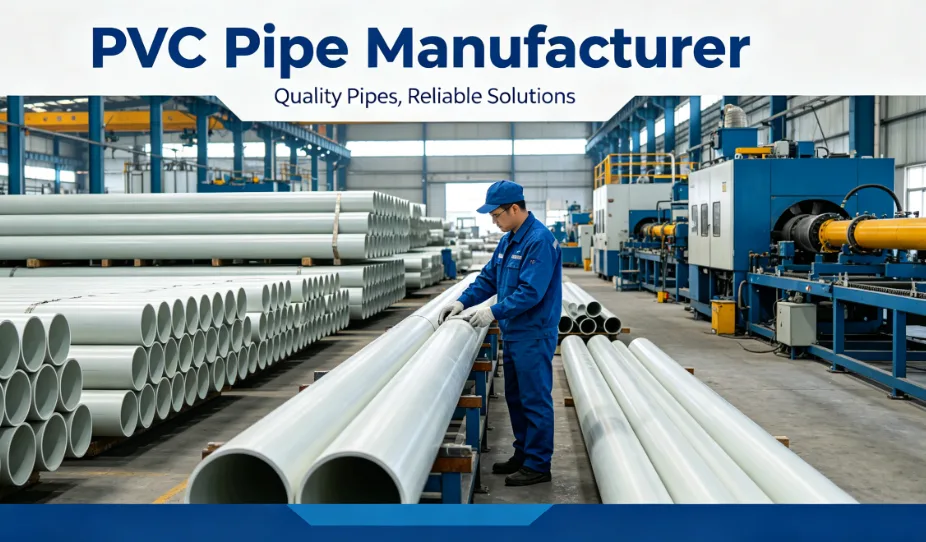
Understanding PVC Pipe Manufacturing Standards in China
PVC pipes manufactured in China typically follow both domestic and international standards, which determine product quality, pressure rating, and safety compliance.
Key International Standards to Verify
| Standard | Region | Application |
|---|---|---|
|
ASTM D1785 / D2241 |
USA |
Pressure pipes |
|
ISO 4422 / ISO 3633 |
Global |
Water supply systems |
|
EN 1452 |
Europe |
Drinking water pipes |
|
GB/T 10002 |
China |
National PVC pipe standard |
Chinese manufacturers capable of exporting globally often comply with multiple standards simultaneously .
Key insight: A reliable supplier should provide third-party test reports aligned with ASTM, ISO, or EN standards, not just internal quality claims.
Evaluate Raw Material Quality and Formulation
PVC pipe durability depends heavily on resin quality and additive formulation. PVC resin is rarely used in pure form; manufacturers add stabilizers, plasticizers, and impact modifiers to achieve required performance .
Critical Material Factors
-
Virgin PVC resin vs recycled material
-
Stabilizer type (calcium-zinc vs lead-based)
-
Impact resistance modifiers
-
Plasticizer content (for flexibility vs rigidity)
Low-quality suppliers may increase calcium carbonate filler to reduce costs, which can weaken pipe strength and durability.
Key conclusion: Always request material composition sheets (MSDS) and verify whether the pipes use 100% virgin resin for pressure applications.
Assess Manufacturing Capability and Equipment
A reliable PVC pipe manufacturer should demonstrate advanced production infrastructure and process control.
Key Manufacturing Indicators
-
Extrusion Technology PVC pipes are produced using extrusion lines where temperature, screw speed, and die design must be tightly controlled .
-
Automation Level Modern factories use automated calibration, cooling, and cutting systems for consistent dimensions.
-
Production Capacity Large-scale manufacturers ensure stable supply for bulk orders.
-
In-house Testing Facilities Reliable suppliers operate labs for:
-
Hydrostatic pressure testing
-
Impact resistance testing
-
Dimensional accuracy verification
-
Practical benchmark: Manufacturers with ISO-certified production lines and European equipment generally offer higher consistency.
Verify Certifications and Quality Management Systems
Certification is one of the most reliable indicators of supplier credibility.
Essential Certifications
-
ISO 9001 (Quality Management System)
-
ISO 14001 (Environmental Management)
-
ISO 45001 (Occupational Safety)
-
CE Certification (for EU markets)
-
NSF or WRAS (for potable water systems)
Many established Chinese manufacturers hold ISO certifications and operate under standardized quality management systems .
Key insight: Certification alone is not sufficient—request valid certificates with issuing authority verification.
Inspect Product Range and Technical Specifications
A reliable manufacturer should offer a comprehensive product portfolio that matches different applications.
Typical Product Categories
-
UPVC water supply pipes (PN6–PN25)
-
PVC drainage pipes
-
CPVC pipes (high-temperature systems)
-
Electrical conduit pipes
Important Technical Parameters
| Parameter | Why It Matters |
|---|---|
|
Diameter range |
Determines flow capacity |
|
Pressure rating (PN / SCH) |
Ensures system safety |
|
Wall thickness |
Affects durability |
|
Temperature resistance |
Critical for industrial use |
For example, Chinese manufacturers typically supply pipes ranging from 20 mm to 800 mm with pressure ratings up to PN25 .
Evaluate Export Experience and Compliance
Export experience directly impacts reliability, especially for international buyers.
Key Export Indicators
-
Experience exporting to North America, EU, Middle East
-
Familiarity with customs documentation and certifications
-
Ability to meet regional compliance requirements
Manufacturers supplying global markets usually align with ASTM, ISO, and EN standards simultaneously .
Key insight: Export-oriented factories typically have stricter quality control compared to domestic-only suppliers.
Conduct Factory Audits and Sample Testing
Before finalizing a supplier, perform independent verification.
Recommended Evaluation Steps
-
Factory Audit
-
Production line inspection
-
Warehouse and inventory check
-
Quality control procedures
-
-
Sample Testing
-
Pressure resistance test
-
Impact strength test
-
Dimensional accuracy
-
-
Third-Party Inspection
-
SGS / TÜV inspection reports
-
Batch testing verification
-
Key conclusion: Reliable manufacturers are transparent and willing to support third-party inspections.
Compare Pricing vs Quality (Avoid the Lowest Price Trap)
Price variation among Chinese PVC manufacturers can be significant. Extremely low prices often indicate:
-
Use of recycled materials
-
Lower wall thickness
-
Reduced stabilizer quality
While China offers cost advantages, selecting solely based on price increases long-term risk.
Key principle: Evaluate total lifecycle cost, not just unit price.
Build a Long-Term Supplier Relationship
Reliable procurement is not a one-time transaction. Long-term cooperation improves consistency and reduces risk.
Best Practices
-
Establish technical specifications agreement
-
Use trial orders before bulk purchase
-
Implement quality inspection protocols
-
Maintain regular communication with engineering teams
A strategic supplier partnership improves product reliability and supply chain stability.
Key Takeaways for Choosing a PVC Pipe Manufacturer
-
Verify international certifications (ISO, ASTM, EN)
-
Ensure high-quality raw materials (virgin PVC resin)
-
Assess manufacturing technology and testing capability
-
Prioritize export experience and compliance knowledge
-
Conduct factory audits and third-party inspections
-
Balance price with long-term performance
FAQ: Choosing PVC Pipe Manufacturers in China
1. What certifications should a reliable PVC pipe manufacturer have?
A reliable manufacturer should hold ISO 9001 for quality management and comply with ASTM, ISO, or EN standards. For potable water applications, additional certifications such as NSF or WRAS are often required depending on the export market.
2. How can PVC pipe quality be tested before purchase?
PVC pipe quality can be verified through hydrostatic pressure testing, impact resistance tests, and dimensional inspections. Third-party inspection agencies such as SGS or TÜV can provide independent verification of product compliance.
3. Is it safe to import PVC pipes from China?
Importing PVC pipes from China is safe when suppliers comply with international standards and provide verifiable certifications. Many Chinese manufacturers produce pipes for global markets with strict quality control processes.
4. What is the difference between Schedule 40 and Schedule 80 PVC pipes?
Schedule 40 pipes have thinner walls and are suitable for general applications, while Schedule 80 pipes have thicker walls and higher pressure resistance. The choice depends on system pressure requirements and application conditions.
5. How important is raw material quality in PVC pipes?
Raw material quality is critical because it directly affects strength, durability, and chemical resistance. Pipes made with virgin PVC resin typically perform better than those using recycled materials, especially in pressure applications.


